How Provider Failure Can Affect Your Leased IPv4 Space
Leased IPv4 addresses may appear stable while they are routed, reachable and supporting production services. However, their operational reliability depends on much more than whether the addresses are working today.
Behind every leased IPv4 block is a structure of contracts, routing permissions, registry records, technical authorisations and provider relationships. If one critical party in that structure fails, the lessee may lose more than access to an address range.
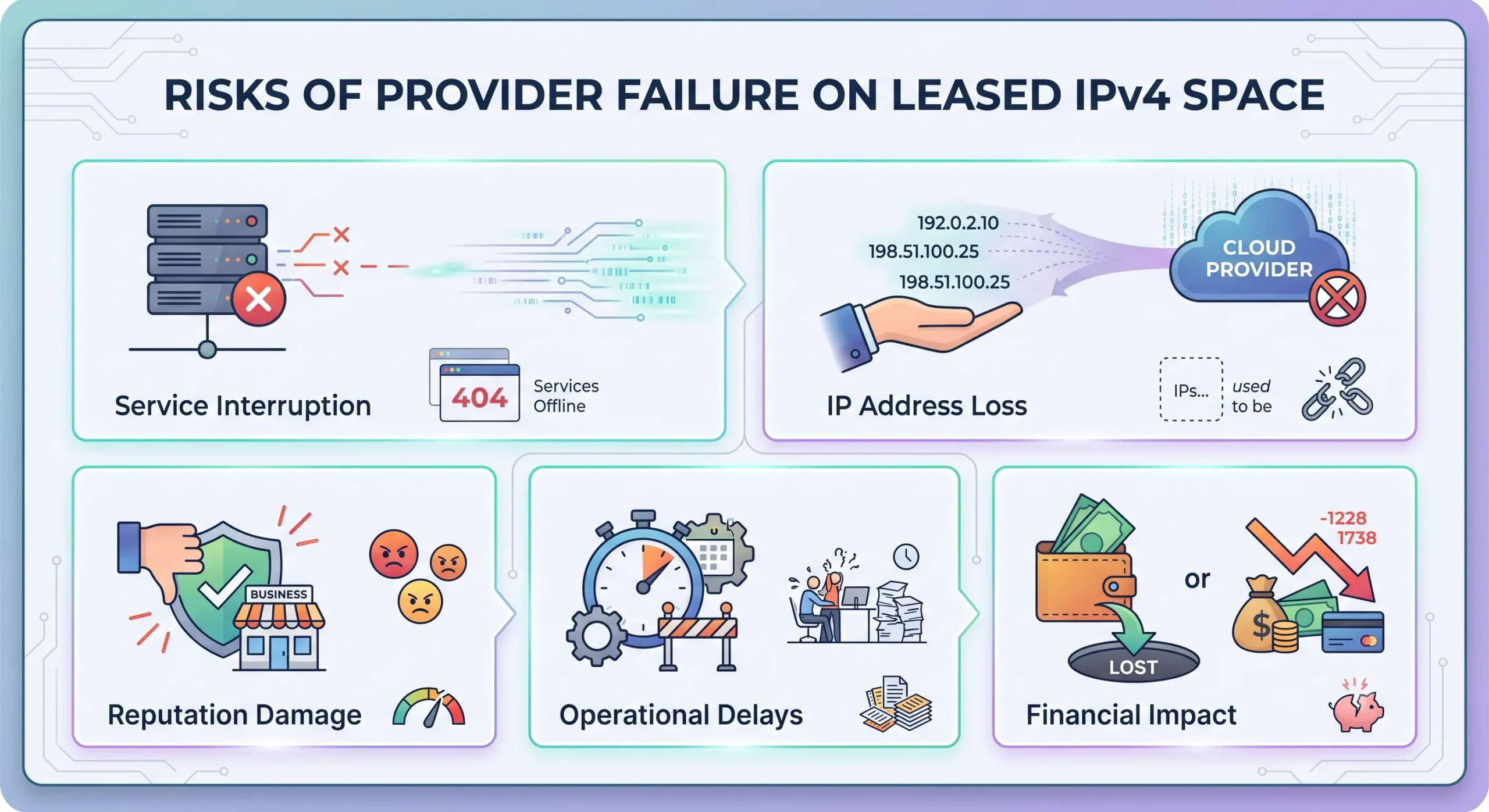
Provider failure can affect customer services, security controls, email delivery, partner integrations and revenue-generating infrastructure.
For organisations that depend on persistent IP addresses, understanding these risks is an essential part of infrastructure continuity planning.
Key Points
- Provider failure can interrupt routing, renewal, registry support and abuse management, even when the lease has not formally expired.
- The company invoicing the lessee may not be the organisation that ultimately controls the IPv4 resource.
- Replacing a production IPv4 block may require changes to DNS, firewalls, VPNs, APIs, customer allowlists and reputation systems.
- Public registry records do not always reveal the complete chain of commercial and operational control.
- First-party supply can reduce intermediary dependency, but it does not remove the need for contractual and technical due diligence.
- Strong IPv4 continuity depends on clear sourcing, enforceable agreements, portable routing documentation and a tested migration plan.
Provider Failure Does Not Always Mean the Company Disappears
When businesses hear the term “provider failure,” they may imagine bankruptcy or the provider shutting down completely.
That is only one possible scenario.
An IPv4 provider can fail operationally while continuing to trade. Provider failure may include:
- Losing the contractual right to supply the address space
- Failing to renew an upstream agreement
- Entering a dispute with the registered resource holder
- Losing access to a registry account
- Withdrawing or delaying routing authorisation
- Failing to maintain IRR or RPKI records
- Becoming unable to respond to abuse complaints
- Experiencing legal, financial or governance problems
- Ending a service without sufficient transition notice
In some cases, the IP addresses may continue working temporarily after the underlying commercial relationship has broken down.
This creates a dangerous gap between apparent technical stability and actual operational security.
As discussed in Why IPv4 Address Continuity Is Becoming a System-Level Business Requirement, businesses increasingly build authentication rules, customer access controls, security policies and operational processes around persistent IP identity.
Losing that identity can therefore create consequences far beyond the network team.
The Provider You Pay May Not Control the IPv4 Block
Many IPv4 leasing arrangements involve more than two parties.
A business may receive addresses from a reseller that obtained them from a broker. The broker may have an agreement with another operator, which ultimately depends on the registered resource holder.
This type of arrangement is not automatically unsafe. However, every additional dependency creates another potential failure point.
Before leasing an IPv4 block, the customer should understand:
- Who is the registered holder?
- Who has contractual authority to lease the addresses?
- Who can issue or renew the Letter of Authorization?
- Who maintains registry and routing records?
- Who can approve a change of origin ASN?
- Who is responsible for abuse cases?
- Who controls renewal?
- What happens if an upstream agreement ends?
This issue is often described as IPv4 provider-chain risk.
An address block can be fully routable while the permissions and relationships supporting it remain fragile. When those dependencies are hidden, the customer may discover the weakness only after the block has become essential to production.
Heng Lu’s Note: Registry Recognition Is Not the Same as Operational Continuity
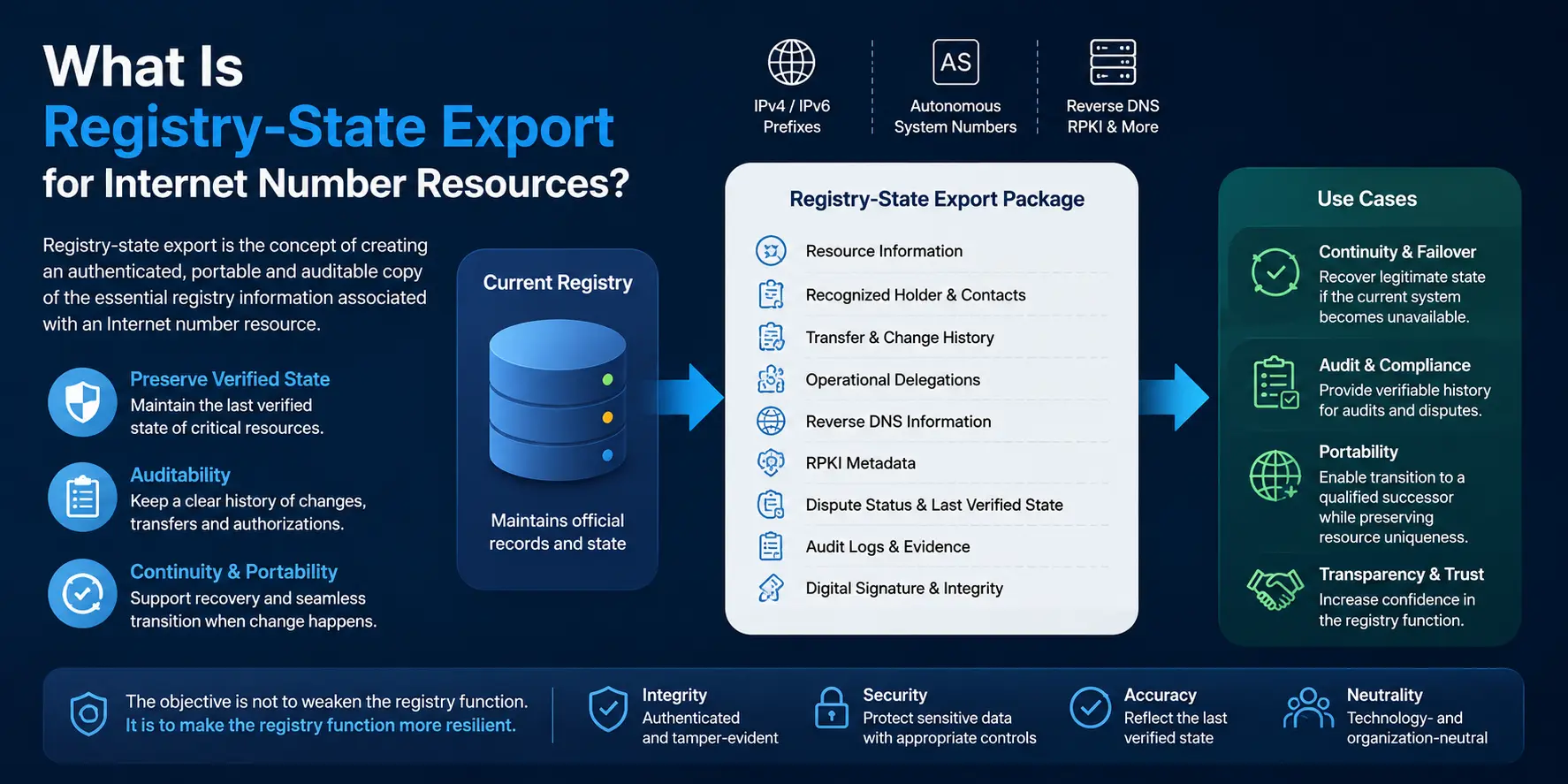
In Note 51: Why the Present Registry Model Becomes Impossible Once IPv4 Becomes a Real Asset, Lu Heng examines the limitations of a registry framework developed when IP addresses were primarily treated as technical identifiers rather than commercially significant infrastructure assets.
That distinction matters for organisations leasing IPv4 space.
A registry record may identify the recognised holder of an address block, but it does not automatically guarantee that every contractual, commercial and operational dependency surrounding the block is secure.
The lessee may still depend on several parties for routing permission, renewal, record maintenance and dispute resolution.
Editorial takeaway from Heng Lu’s Note 51: A correct registry entry is important, but it does not remove the contractual, governance and continuity risks surrounding an operational IPv4 resource.
This is why IPv4 due diligence must examine the complete chain of control rather than relying solely on the public registration record.
1. Your Routes May Be Withdrawn or Rejected
A leased IPv4 block creates value only when it can be announced and accepted across the internet.
The lessee commonly depends on several routing components:
- A valid Letter of Authorization
- Correct Internet Routing Registry objects
- Appropriate Route Origin Authorizations
- Upstream acceptance of the announcement
- Cooperation from the registered holder or authorised provider
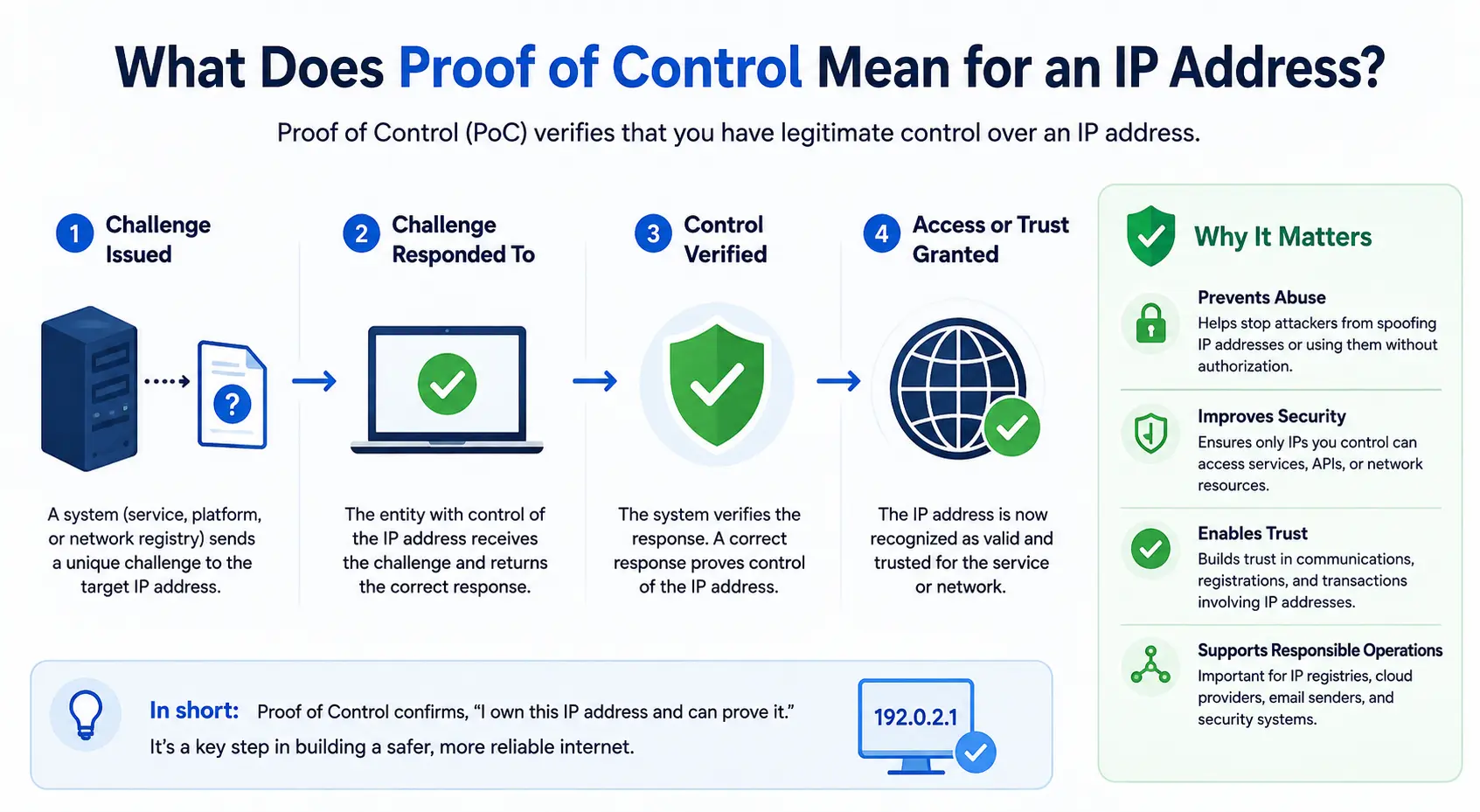
A Letter of Authorization, commonly known as an LOA, documents permission for a network to announce a specific IP prefix.
If the authorising party withdraws that permission, refuses to renew it or becomes unavailable, the lessee may struggle to maintain or change the route.
The LARUS guide to the role of an LOA in IPv4 leasing explains why routing authorisation forms part of both the technical and commercial structure supporting a leased address block.
A route does not always disappear immediately when a commercial dispute begins.
The address block may continue operating under its existing configuration. However, the lessee may become unable to:
- Change the origin ASN
- Move to another upstream provider
- Update route objects
- Replace an expired LOA
- Correct invalid routing records
- Respond when another network rejects the announcement
The block may therefore remain usable during normal operations but become extremely difficult to manage during a migration or incident.
2. Renewal May Become Impossible
A lease renewal often depends on parties the customer never sees.
The direct provider may intend to renew the customer’s contract but lack the authority to do so because:
- Its own upstream lease has ended
- The registered holder wants the addresses returned
- The provider has breached another agreement
- The block is being prepared for sale or transfer
- A registry or legal dispute has restricted control
- The supplier can no longer meet its financial obligations
The result may be a non-renewal notice, a sudden price increase or a requirement to return the address block on short notice.
A statement such as “renewable annually” is therefore weaker than a clearly documented renewal mechanism.
A reliable arrangement should explain:
- Who has the authority to approve renewal
- How much notice must be provided
- Whether renewal is automatic or discretionary
- How renewal pricing is determined
- What happens if the provider loses access to the resource
- What transition support is available if renewal becomes impossible
Without these protections, the customer may have a contract with one company while the actual renewal decision rests with another.
3. Registry and Documentation Problems May Reach Your Network
Leased IPv4 operations depend on accurate administrative and technical records.
Problems involving the registered entity, outdated contacts, expired authorisations, incomplete transfer records or missing routing documentation may initially appear to be paperwork issues.
In practice, they can delay:
- Routing changes
- Provider migrations
- Lease renewals
- Abuse investigations
- Security reviews
- Resource verification
- Incident resolution
A review may uncover inaccurate WHOIS or RDAP information, stale IRR objects, expired LOAs, unknown BGP announcements or incomplete agreements.
These weaknesses can affect continuity, security, transferability and the practical value of the IPv4 resource.
Provider failure makes documentation gaps even harder to resolve.
If the provider’s employees, systems or legal entity are no longer available, obtaining replacement authorisation or proving the operating relationship may take considerably longer than expected.
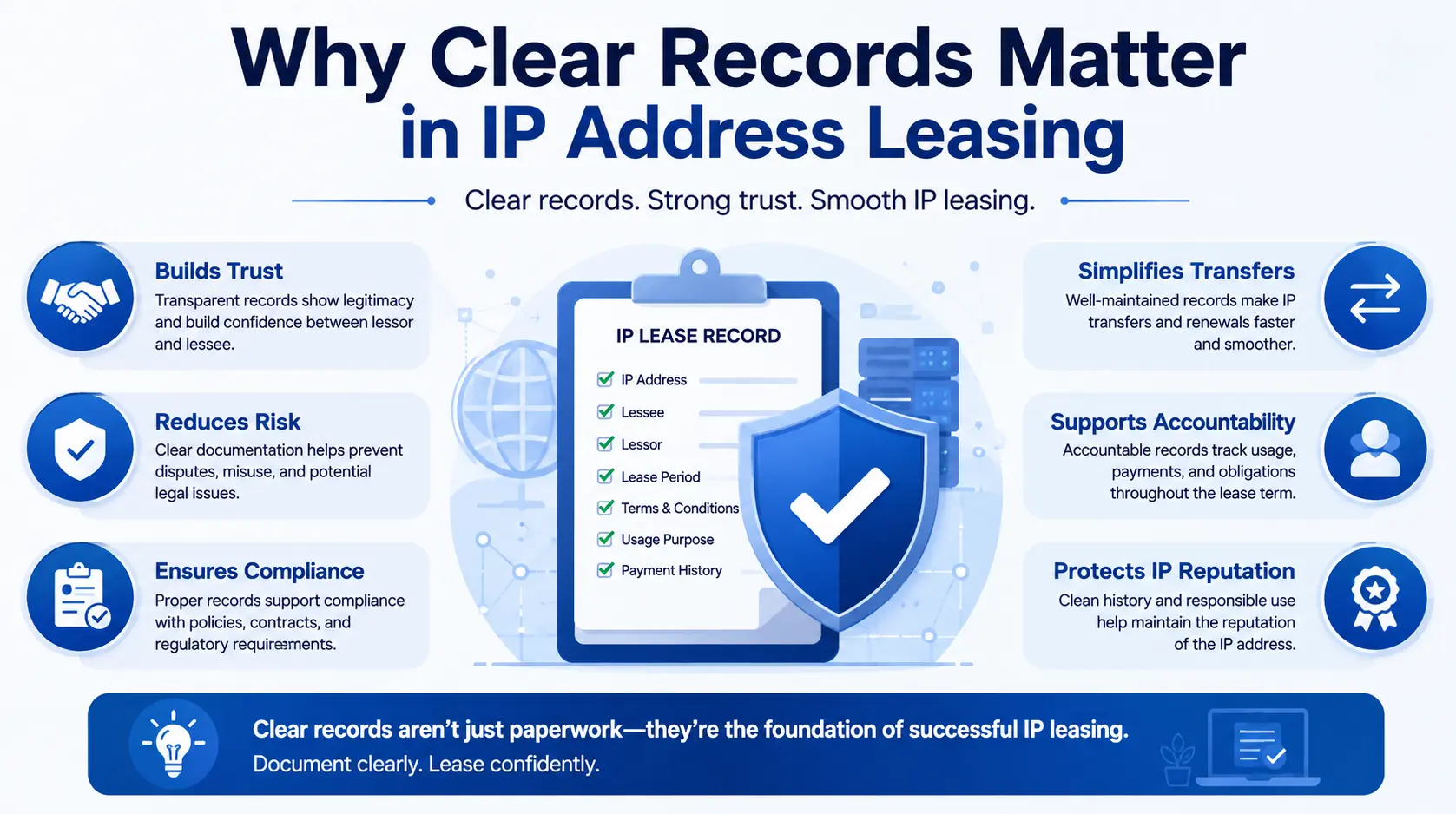
For that reason, lessees should retain copies of:
- Lease agreements
- Letters of Authorization
- Routing records
- RPKI information
- Support correspondence
- Renewal confirmations
- Abuse-management contacts
- Provider escalation procedures
Technical resources available through LARUS can also help operators understand the authorisations, routing controls and operational responsibilities involved in maintaining usable IPv4 space.
4. Abuse and Reputation Issues May Go Unmanaged
IPv4 reputation is part of the practical utility of an address block.
Leased addresses may be assessed by:
- Email filtering systems
- Hosting and security platforms
- Fraud-prevention services
- Search engines
- Advertising networks
- Threat-intelligence databases
- Customer security teams
- Anti-spam and blocklist operators
When malicious or prohibited activity is reported, someone must investigate the complaint, coordinate with the user, communicate with external parties and protect the wider prefix.
A provider experiencing operational failure may stop responding to abuse reports or fail to maintain clear escalation channels.
This can allow reputation problems to grow.
Even when the lessee did not cause the original issue, neighbouring activity or poor historical management can affect:
- Email deliverability
- Website accessibility
- Customer trust
- Advertising access
- Payment processing
- Security-platform acceptance
Replacing the block may not immediately solve the problem.
A new address range must be added to customer systems, recognised by external platforms and allowed to build its own reputation.
5. Renumbering Can Become a Business-Wide Incident
Changing a production IP address is rarely a single configuration update.
An emergency migration may require changes to:
- DNS records
- Firewalls and access-control lists
- VPN endpoints
- API integrations
- Customer allowlists
- Monitoring systems
- Web server configurations
- Load balancers
- Mail server records
- Licensing systems
- Geolocation databases
- DDoS-protection services
- Security and compliance documentation
Partners and customers may also need to update their own configurations.
Some changes can be completed quickly. Others depend on external approval processes, change-control procedures or scheduled maintenance windows.
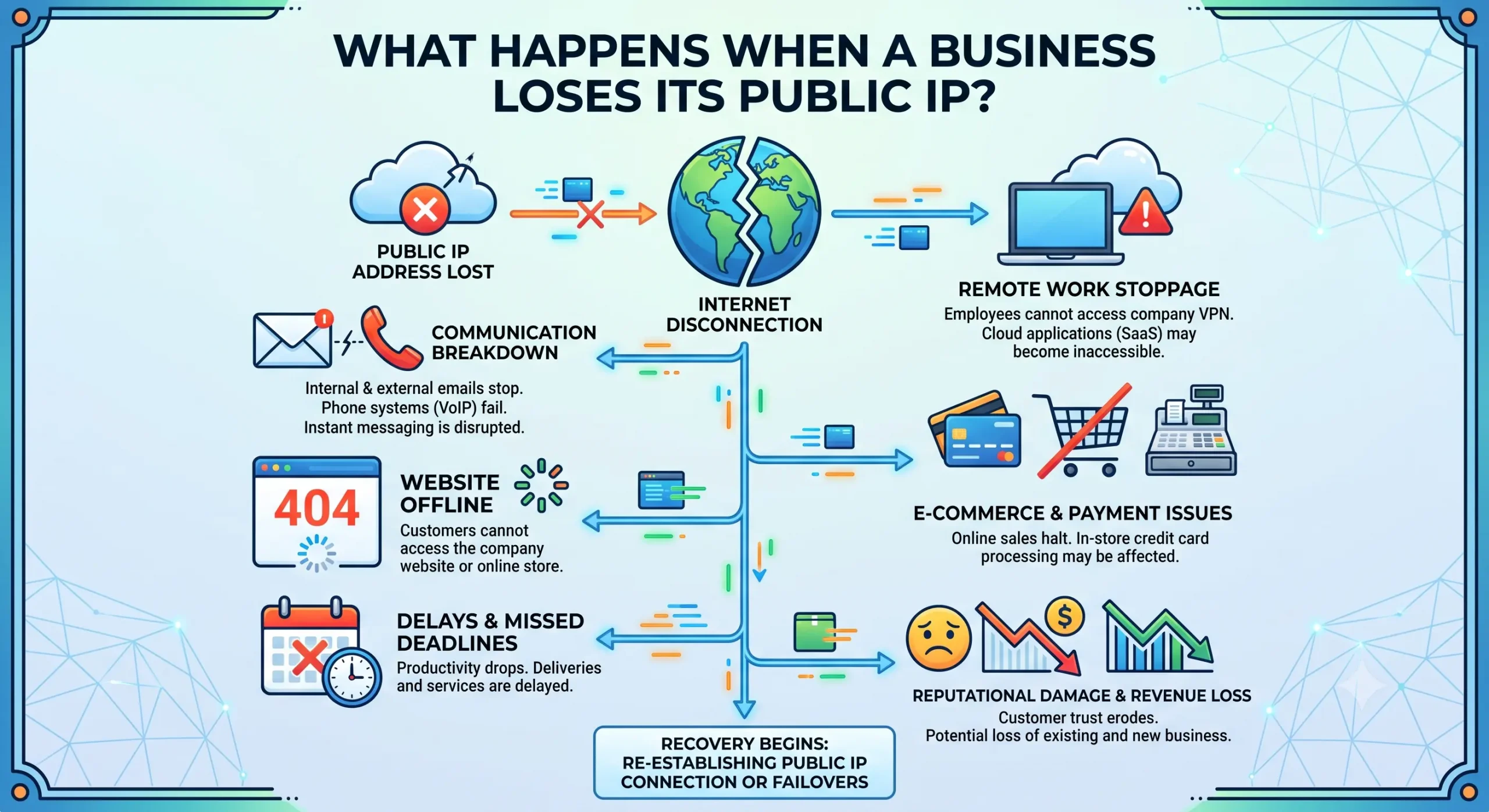
When IPv4 continuity is lost, organisations may face:
- Failed integrations
- Security blocks
- Customer complaints
- Service interruptions
- Emergency engineering work
- Contractual exposure
- Revenue loss
The operational burden may extend across network, security, legal, finance, commercial and customer-support teams.
The cost of provider failure is therefore not limited to the price of securing replacement IPv4 addresses.
It also includes engineering time, support demand, delayed launches, contractual risk and reputational damage.
6. Emergency Replacement Weakens Your Negotiating Position
IPv4 sourcing is easier when it is planned.
A company facing immediate termination has fewer choices and less time to conduct due diligence.
It may need to accept:
- Higher prices
- Less favourable contract terms
- Shorter lease periods
- Address blocks with limited reputation history
- A different prefix size
- Another complicated provider chain
- An untested deployment schedule
This can replace one continuity risk with another.
Emergency procurement also compresses the review process.
Teams that would normally examine address history, routing readiness, contractual authority and renewal controls may focus only on how quickly the replacement block can be announced.
A resilient IPv4 strategy should identify replacement options before the existing provider relationship becomes unstable.
How to Reduce Provider-Failure Risk
Provider failure cannot always be prevented, but its effect can be reduced.
Verify Who Controls the Resource
Ask the provider to identify the registered holder and explain its authority to supply the block.
A vague answer such as “we work with global partners” does not provide enough information for business-critical infrastructure.
The provider should be able to explain the chain of control without exposing unrelated confidential information.
The customer should understand who controls:
- The lease
- The renewal
- The LOA
- The IRR records
- The RPKI records
- The abuse contact
- The right to request the addresses back
Examine the Contract Beyond Price and Term
An IPv4 lease should address:
- The exact prefixes being supplied
- Permitted and prohibited use
- Renewal rights
- Termination notice
- Provider insolvency
- Upstream-provider failure
- Routing-authorisation responsibilities
- Registry and IRR support
- Abuse-management obligations
- Transition assistance
- Documentation handover
- Return and de-announcement procedures
The agreement should explain what happens when the provider can no longer deliver the service, rather than addressing only customer breach.
Confirm Routing Portability
Determine whether the address space can be announced from your ASN and whether the necessary authorisations can be updated when you change upstream connectivity.
A block that works only through one provider-controlled network may create deeper dependency than a portable arrangement.
Questions to ask include:
- Can the prefix be announced from our ASN?
- Can the origin ASN be changed?
- Who updates the route object?
- Who creates or changes the ROA?
- How quickly can a new LOA be issued?
- Can the block move between upstream providers?
Routing portability does not eliminate every risk, but it can reduce the operational effect of a connectivity-provider failure.
Maintain an IPv4 Dependency Inventory
Document every system, customer and partner that depends on each leased prefix.
The inventory should include:
- DNS records
- Firewall rules
- VPN configurations
- APIs
- Mail infrastructure
- Customer allowlists
- Security platforms
- External service providers
- Internal system owners
This allows the business to estimate the real migration effort before an incident occurs.
The inventory should also identify which dependencies can be changed internally and which require action by customers or third parties.
Monitor the Provider Relationship
Continuity reviews should not take place only at renewal.
Watch for warning signs such as:
- Slow or inconsistent support responses
- Changes in payment instructions
- Repeated routing errors
- Missing documentation
- Unexplained registry changes
- Sudden contract amendments
- Difficulty obtaining an updated LOA
- Changes in the provider’s upstream relationships
- Abuse cases that remain unresolved
- Unexpected requests to renumber
Individual warning signs may have innocent explanations.
Several appearing together should trigger a formal continuity review.
Create a Tested Migration Plan
A continuity plan should identify:
- Alternative IPv4 supply
- Migration sequencing
- DNS preparation
- Routing preparation
- Customer communication
- Partner notification
- Security-rule updates
- Rollback procedures
- Internal decision-makers
The plan should be reviewed before lease renewal, network expansion, provider changes and major customer migrations.
A plan that has never been tested is only a document.
Where possible, organisations should rehearse the migration of a non-critical service or test prefix before an emergency occurs.
Operators preparing an alternative sourcing strategy may review providers and technical resources through platforms such as i.lease and LARUS before a provider issue becomes urgent.
Choose Providers Based on Failure Handling
The critical question is not simply whether a provider can deliver an IPv4 block.
The better question is:
What happens when something goes wrong?
A reliable provider should have a clear answer covering:
- Routing
- Renewal
- Documentation
- Abuse handling
- Escalation
- Migration
- Transition support
Businesses seeking structured marketplace access can review i.lease.
Organisations evaluating IPv4 leasing and resource-management options can also explore LARUS.
A direct or first-party leasing model can reduce provider-chain risk when the provider controls the resource and clearly accepts responsibility for routing, renewal, documentation and support.
However, first-party supply should not be treated as an automatic guarantee of continuity.
Customers must still review the contract, understand the available service protections and confirm how the provider handles operational failure.
The purpose of provider due diligence is not to eliminate every possible risk.
It is to ensure that responsibilities remain clear and that the customer has a realistic path forward when normal operations break down.
The Bottom Line
Leased IPv4 space is not protected simply because the addresses are working today.
Its continuity depends on the strength of the commercial and technical structure behind it:
- Who controls the resource
- Who can authorise routing
- Who maintains the records
- Who manages abuse
- Who approves renewal
- Who remains accountable when the relationship breaks
Provider failure can turn an apparently routine IPv4 lease into an urgent infrastructure migration.
The organisations best positioned to manage that event are those that understand their provider chain, negotiate continuity protections and prepare replacement options in advance.
IPv4 leasing remains a practical way to scale without committing significant capital to outright acquisition.
However, leased address space should be treated as an operational dependency, not merely as a temporary purchasing arrangement.
The goal is not simply to obtain IPv4 addresses.
The goal is to ensure that the systems built on those addresses can continue operating when the provider comes under pressure.
FAQs
The addresses may continue routing temporarily, but renewal, support, routing changes and authorisation can become uncertain.
The outcome depends on the provider’s rights, its upstream agreements, the registered holder and the terms of the customer’s lease.
A provider may require the addresses to be returned when the lease ends or under termination conditions stated in the agreement.
The contract should clearly define notice periods, renewal rights, termination events and transition support.
No.
An LOA confirms routing authorisation, but continuity also depends on the validity of the document, the authority of the issuer, registry records, RPKI configuration, upstream acceptance and the underlying lease relationship.
The required period depends on the complexity of the deployment.
Networks involving customer allowlists, email infrastructure, VPNs, APIs and external integrations may require significantly more preparation than a standalone service.
The necessary migration period should be evaluated before signing the lease.
It can reduce intermediary dependencies when the provider directly controls the address pool and clearly accepts responsibility for routing, renewal, documentation and operational support.
However, customers must still examine the specific contract, service protections and continuity procedures.