Why Clear Operational Records Matter in IP Address Leasing
IP address leasing often involves more than a simple relationship between a resource provider and a customer.
The registered resource holder, lessee, network announcing the prefix, RPKI administrator, reverse DNS operator, and technical contacts may all be different parties. Clear operational records help these relationships remain understandable as infrastructure, providers, routing arrangements, and leases change.
The principle is simple:
Good operational records should describe how an IP resource is actually being used and managed.
They should make responsibility clearer without turning ordinary commercial arrangements into unnecessary layers of control.
What Are Operational Records in IP Address Leasing?
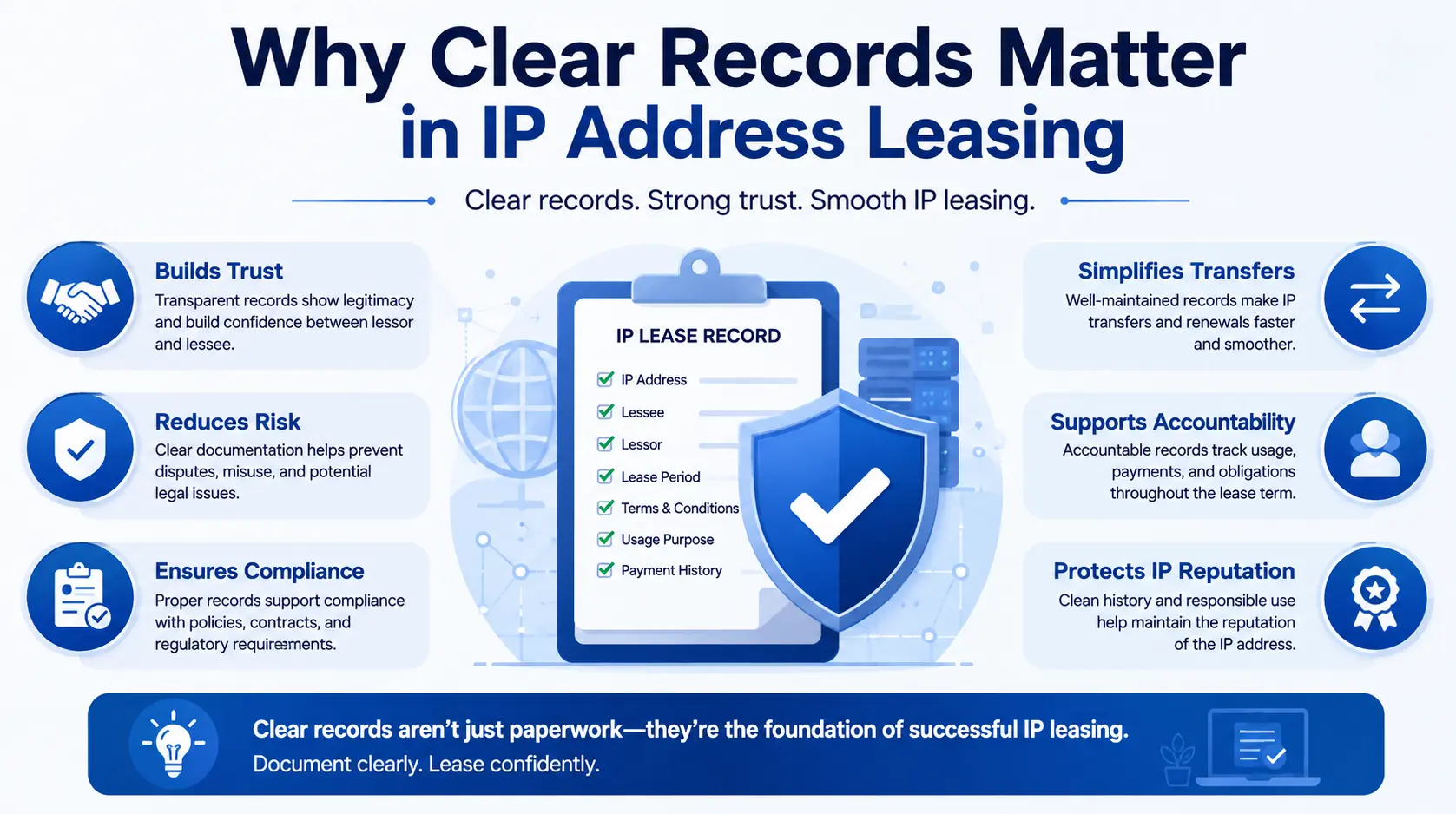
Operational records are the information and documentation that describe the current operational state of an IP address block.
Depending on the arrangement, they may identify:
the registered resource holder;
the current lessee or operational user;
the network announcing the prefix;
the intended origin ASN;
routing authorization;
RPKI and Route Origin Authorization information;
reverse DNS responsibility;
technical, administrative, and abuse contacts;
the effective period of the lease or delegation;
material provider or routing changes; and
relevant authorization and change history.
Not all of this information needs to be publicly visible.
Privacy, contractual obligations, security requirements, registry practices, and applicable law may influence where information is maintained and who can access it.
What matters is that the relevant parties can establish a consistent picture of the resource’s operational state when they need to.
The Resource Holder and Resource User May Be Different
One of the most important distinctions in IPv4 leasing is the difference between the resource holder and the operational user.
In a leasing arrangement, the organization recorded as the resource holder may remain unchanged while another organization uses the addresses.
A simplified relationship might look like this:
Resource holder → lessor → lessee → network provider → upstream network
The exact structure varies.
The lessee may operate applications using the addresses.
A hosting provider may announce the prefix.
Another party may manage RPKI.
Reverse DNS may be administered separately.
These roles are related, but they do not necessarily mean the same thing.
That is why no single record always provides the complete operational picture.
A registry record describes one layer.
A BGP announcement describes routing reality.
A ROA describes route-origin authorization.
A lease agreement documents a commercial relationship.
Reverse DNS describes another operational function.
Good IP resource management keeps these layers sufficiently aligned so that the current operational state remains understandable.
1. Keep the Resource Holder Identifiable
The recognized resource holder should remain identifiable throughout the lease lifecycle.
At the same time, the operational relationship with the lessee can be documented at an appropriate level.
This gives the parties a clearer reference point when questions later arise about:
routing changes;
authorization;
provider migrations;
renewals;
technical incidents;
transfers; or
the end of a lease.
The objective is not to make leasing more bureaucratic.
It is to make the operational state easier to establish.
A useful principle is that records should reflect operational reality rather than attempt to replace it.
This distinction also appears in Heng Lu’s broader discussion of registry accuracy in The Bill of Rights of Uniqueness Coordination.
2. Document Who Is Authorized to Route the Prefix
An IPv4 block becomes operationally useful when it can be routed.
For leased address space, the parties should therefore be able to answer two basic questions:
Which ASN is expected to originate the prefix?
Who authorized that routing arrangement?
This becomes particularly important when infrastructure changes.
For example:
the lessee changes data centers;
an upstream provider changes;
a hosting provider is replaced;
the origin ASN changes;
the network is migrated; or
the lease continues under a different delivery arrangement.
Without clear routing records, an ordinary infrastructure change can become unnecessarily difficult to investigate.
Documenting routing responsibility helps operators distinguish an expected change from an unexpected one.
3. Keep RPKI Aligned With Routing Reality
RPKI provides a way to publish cryptographically verifiable information about which Autonomous System is authorized to originate a prefix.
That makes it relevant to the operational lifecycle of leased IPv4 space.
Consider a lease moving from one network environment to another.
The commercial arrangement may change.
The BGP announcement may change.
The intended origin ASN may change.
If the relevant ROA is not reviewed at the same time, however, the routing-security information may continue to describe the previous arrangement.
Different operational layers then begin telling different stories.
For this reason, RPKI should not necessarily be treated as a one-time configuration task.
Where an intended origin changes, operators should review whether the relevant Route Origin Authorization also needs to change.
The goal is straightforward:
Routing authorization should remain consistent with the network arrangement it is intended to describe.
4. Include Reverse DNS in the Operational Plan
Reverse DNS can matter to more than network administration.
PTR records may be relevant to:
email infrastructure;
security systems;
logging;
diagnostics;
reputation systems; and
certain application workflows.
An IPv4 lease should therefore have a clear answer to another question:
Who manages reverse DNS for the leased addresses?
Depending on the arrangement, that responsibility might sit with:
the resource holder;
the lessor;
the lessee;
the hosting provider; or
another network operator.
The important point is that the responsibility should be understood before a change becomes urgent.
A prefix may continue routing correctly after a provider migration while its reverse DNS configuration still reflects an older environment.
Operational continuity therefore involves more than keeping the route alive.
Supporting operational records should also follow material infrastructure changes.
5. Make Contact Responsibilities Clear
Leased IP resources may generate several different kinds of operational requests.
These can include:
routing questions;
technical incidents;
RPKI changes;
reverse DNS requests;
security reports;
abuse reports; and
registry-related questions.
The person responsible for the commercial lease may not manage routing.
The network engineer may not handle abuse reports.
The registered holder may not operate the lessee’s infrastructure directly.
Clear operational records should therefore help answer:
Who handles routing changes?
Who manages technical operations?
Who receives abuse-related notices?
Who manages reverse DNS?
Who can authorize operational changes?
Who should be contacted when the lease arrangement changes?
This is fundamentally a coordination issue.
Useful contact records help people reach the right party more quickly when something needs attention.
6. Define the Operational Start and End of the Lease
A lease usually has a commercial beginning and end.
Its operational lifecycle should be equally clear.
At the start of a lease
The parties may need to establish:
the IPv4 prefix being delegated;
the operational user;
the intended origin ASN;
routing authorization;
RPKI configuration where applicable;
reverse DNS arrangements;
technical contacts; and
the activation date.
At the end of a lease
They may need to review:
BGP announcements;
route authorization;
ROAs;
reverse DNS;
operational contacts;
customer delegations; and
preparation of the prefix for future use.
Clear offboarding matters just as much as activation.
A well-managed lease should not only be easy to begin. It should also be possible to unwind cleanly when the relationship ends.
For organizations that manage these operational steps across multiple leases, a more structured managed IPv4 leasing process can be useful because the lifecycle continues after the initial allocation of the addresses.
7. Maintain an Appropriate Change History
Current records tell operators what exists now.
Historical records help explain how the resource reached its present state.
Over time, an IPv4 block may move between:
customers;
networks;
ASNs;
hosting providers;
data centers; or
upstream providers.
An appropriate operational history can help answer questions such as:
When did the current lease begin?
Which organization previously used the prefix?
When did the origin ASN change?
Who authorized the change?
When was the ROA updated?
Who previously managed reverse DNS?
When was the resource returned or reassigned?
This does not mean every internal event must become public information.
It means that organizations responsible for Internet number resources benefit from maintaining an auditable record of material operational changes.
That history becomes especially valuable when staff change, providers change, companies restructure, or an issue must be investigated months after the original configuration.
8. Clear Records Make Provider Changes Easier
Provider changes are one of the clearest examples of why operational records matter.
A company may change its connectivity, hosting, transit, or network provider while continuing to use the same leased IPv4 addresses.
If responsibilities are documented clearly, the transition can follow an understandable sequence:
current routing state → authorization change → new routing state → supporting record updates
The infrastructure changes, but the operational history of the IP resource remains understandable.
This is particularly relevant where address space is intended to remain usable across changing network environments. Provider-independent approaches to IPv4 leasing can make that distinction between the address resource and the delivery network more visible.
The broader principle is important:
Providers can change. Infrastructure can change. Operational records should be capable of following those changes.
This is also consistent with the idea behind Running-Code Primacy: common coordination should remain focused on what independent networks actually require to continue interoperating.
9. Better Records Reduce Ambiguity During Disputes
Documentation cannot prevent every disagreement.
But weak documentation can make even a straightforward disagreement much harder to understand.
Imagine a prefix where:
one organization appears in registry records;
another network announces the prefix;
a third organization says it is the current lessee;
an older ASN remains in a ROA; and
nobody has a reliable record of when the last operational change occurred.
Even if every party acted in good faith, reconstructing the current state can become difficult.
Clear records help separate different questions:
Who is the recognized resource holder?
Who currently uses the addresses?
Who is authorized to route them?
Who manages supporting services?
What changed, when, and under whose authorization?
These distinctions become particularly important when the network is already running.
Administrative uncertainty should be resolved as accurately as possible without creating unnecessary operational uncertainty.
10. Accurate Records Do Not Require Excessive Control
Better operational records should not be confused with broader control over commercial activity.
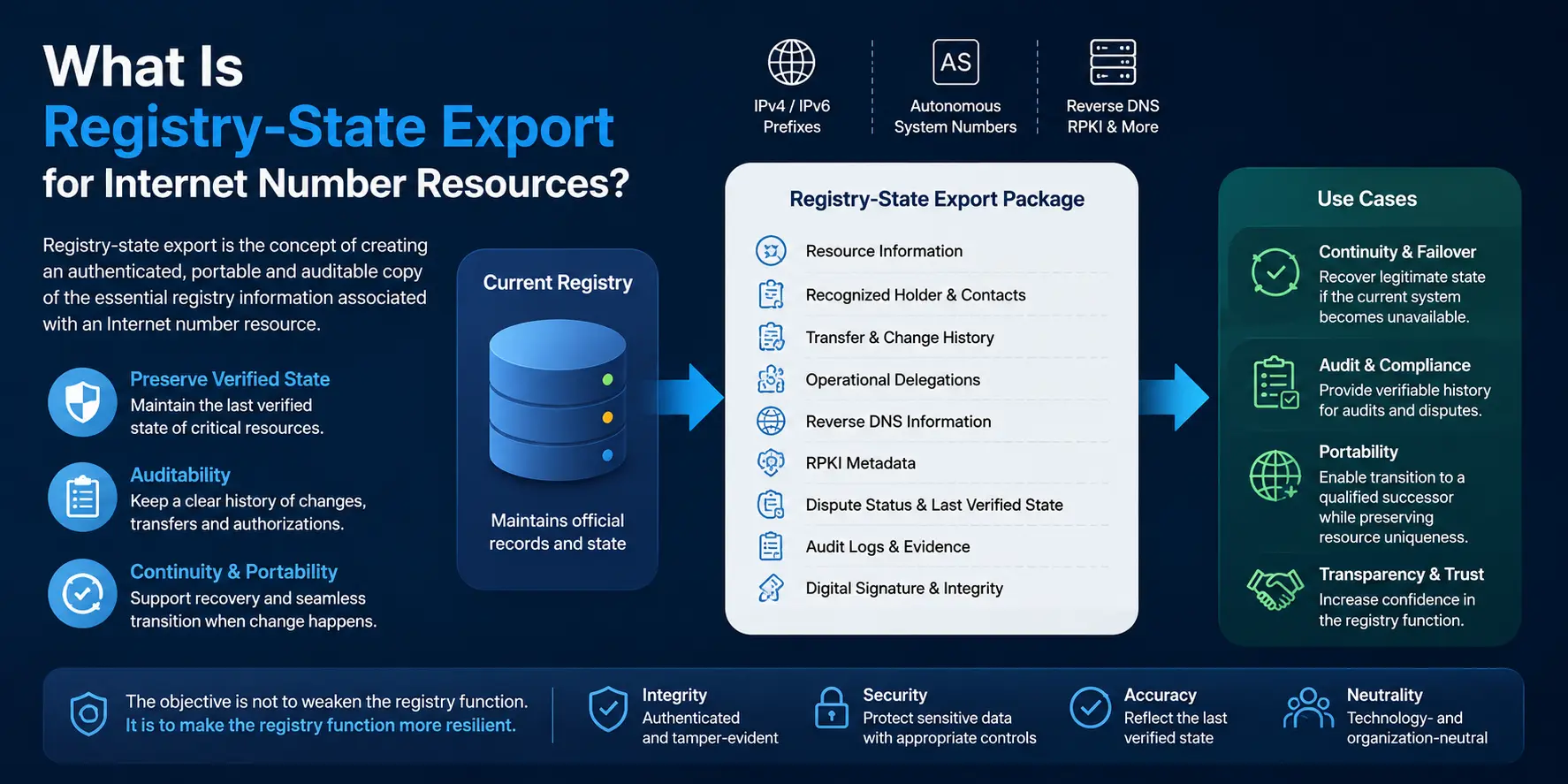
Recognizing a leased resource and documenting relevant operational relationships does not require a registry or coordination system to judge every aspect of the underlying business arrangement.
A focused coordination layer can concentrate on information that supports reliable Internet operation, including:
uniqueness;
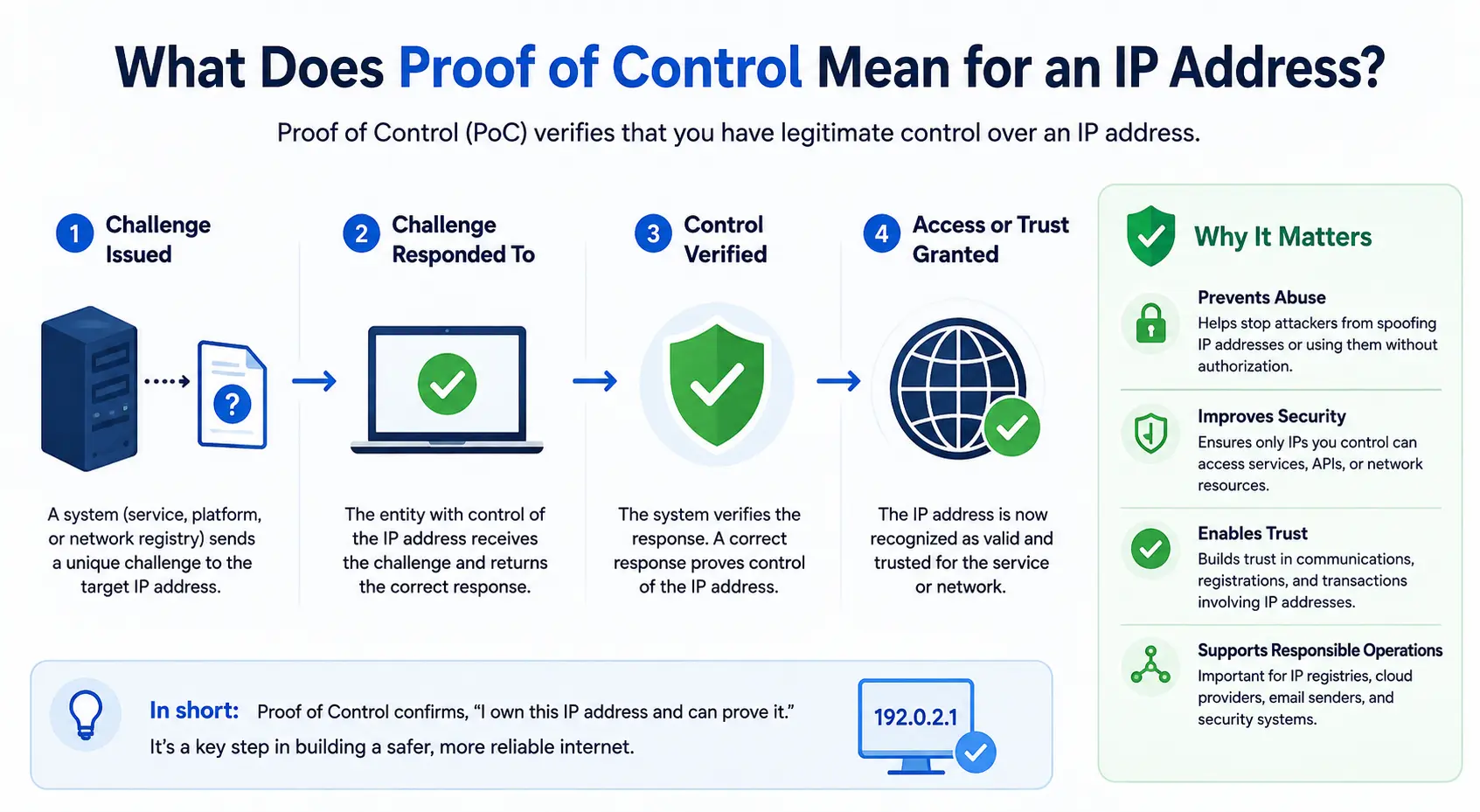
proof of control;
registry accuracy;
relevant security assertions;
transfer or delegation records;
auditability; and
operational continuity.
Other decisions can remain with the parties responsible for them.
Pricing can remain a commercial decision.
Customer selection can remain with the operator.
Lease terms can remain with the contracting parties.
Infrastructure design can remain with the network.
Deployment decisions can remain with the parties operating the service, subject to applicable requirements.
The purpose of accurate records is to make operational reality understandable.
It should not be to turn recordkeeping into a permission system for every network decision.
This distinction is explored more broadly in The Policy Mirror, which argues for clearer recognition of operational delegation while keeping the common registry function focused on the information necessary for coordination.
A Practical Operational Record for Leased IPv4
A well-maintained operational record should make it possible to answer questions like these:
| Area | Question to Answer |
|---|---|
| IPv4 resource | Which prefix is involved? |
| Resource holder | Who is the recognized holder? |
| Operational user | Who is currently using the addresses? |
| Lease period | When does the delegation begin and end? |
| Routing | Which ASN should originate the prefix? |
| Authorization | Who authorized the routing arrangement? |
| RPKI | Does the ROA reflect the intended origin? |
| Reverse DNS | Who manages rDNS and PTR records? |
| Technical contact | Who handles network changes? |
| Abuse contact | Who receives relevant reports? |
| Change history | What material operational changes have occurred? |
| Exit process | What needs to change when the lease ends? |
The exact system used to maintain this information will vary between organizations.
The principle does not.
Someone reviewing the resource should be able to understand its current operational state without reconstructing the entire relationship from scattered contracts, emails, tickets, and routing data.
Clear Records Support a More Reliable IPv4 Leasing Environment
IPv4 leasing is already part of modern Internet infrastructure.
Trying to describe every leased resource with only one label—holder, user, customer, provider, or registry entry—can miss important parts of the operational relationship.
Several layers may exist at the same time.
The resource holder can remain identifiable.
The lessee can use the addresses.
A network can originate the prefix.
RPKI can describe route-origin authorization.
Reverse DNS can be delegated.
Contacts can identify responsible operators.
A change history can show how the resource moved between operational states.
When these relationships remain clear, leased IPv4 becomes easier to operate, troubleshoot, migrate, and maintain.
When they become unclear, even routine infrastructure changes may require unnecessary investigation.
The broader lesson is simple:
Good Internet coordination is not about controlling every decision. It is about keeping the information required for interoperability accurate, useful, and aligned with operational reality.
For IP address leasing, that means understanding who holds the resource, who uses it, who routes it, who manages supporting services, and how those responsibilities change over time.
Conclusion
IP address leasing works best when its operational reality is understandable.
The resource holder should be identifiable.
The operational user should be clear.
Routing authorization should be documented.
RPKI and reverse DNS should remain aligned with relevant network changes.
Contacts should reach the appropriate people.
Material changes should leave an appropriate audit trail.
And the end of a lease should be managed as carefully as its beginning.
None of this requires turning Internet number-resource coordination into control over ordinary commercial decisions.
It requires something much simpler:
accurate records, clear responsibilities, and continuity for running networks.
The record should describe reality.
The documentation should make that reality understandable.
And the network should be able to keep operating as the relationships around it change.
FAQs
Operational records help clarify who holds, uses, routes, and manages leased IP space. They can reduce ambiguity during troubleshooting, provider migrations, routing changes, renewals, and lease termination.
No. In a leasing arrangement, the recognized resource holder and the operational user may be different organizations. Other parties may also provide routing, hosting, or supporting network services.
Useful information may include the prefix, resource holder, operational user, lease period, intended origin ASN, routing authorization, RPKI configuration, reverse DNS responsibility, relevant contacts, and material change history.
Where RPKI is used, a change in the intended origin ASN may require the relevant ROA to be reviewed. This helps keep routing-security information aligned with the current operational arrangement.
It depends on the arrangement. The holder, lessor, lessee, hosting provider, or another network operator may manage it. The important point is that responsibility is clearly defined and can be updated when the arrangement changes.