What Is Registry-State Export for Internet Number Resources?
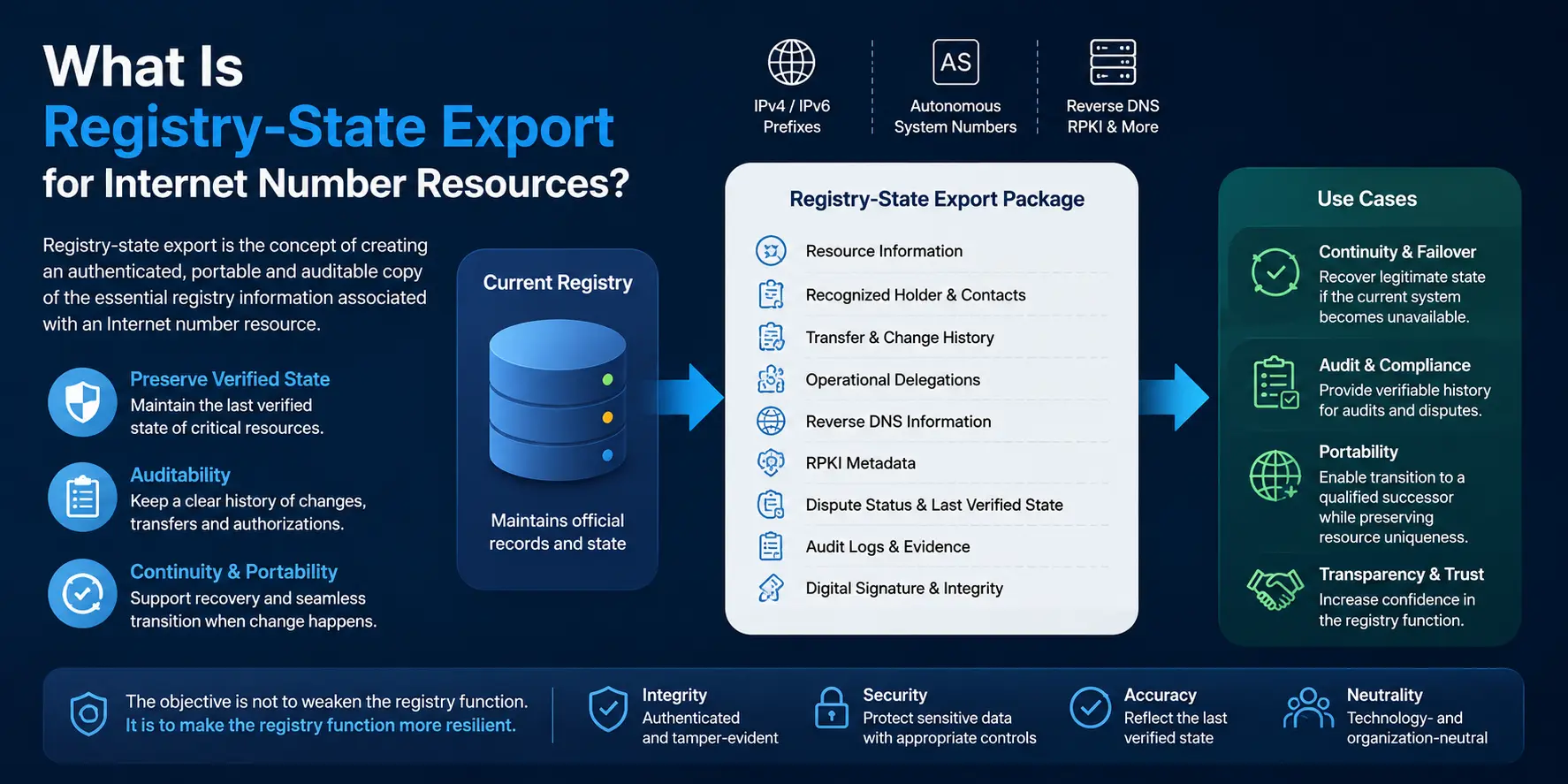
Registry-state export is the concept of creating an authenticated, portable and auditable copy of the essential registry information associated with an Internet number resource. For an IPv4 block, IPv6 prefix or Autonomous System Number, that export could include information such as:- the Internet number resource;
- recognized holder information;
- relevant contact objects;
- registration status;
- transfer history;
- delegation information;
- reverse DNS information;
- RPKI-related metadata;
- dispute or conflict status;
- material change history; and
- audit records needed to understand the current verified state.
If the system currently maintaining a resource record becomes unavailable, disputed or unable to provide essential services, can the legitimate registry state still be independently understood and reconstructed?That makes registry-state export a question of continuity, auditability and portability, not merely data download. It is also important to distinguish the concept from existing protocols such as RDAP. RDAP provides structured access to Internet registration information, but a complete registry-state export would potentially contain additional continuity information, historical context, authorization relationships and audit data needed to reconstruct a resource’s verified state. In other words: RDAP helps you query registry data. Registry-state export would help preserve the state needed for continuity.
Why Does Registry-State Export Matter?
Internet number resources can remain operational for many years. During that time:- companies can change names;
- organizations can merge;
- resources can be transferred;
- addresses can be leased or delegated;
- providers can change;
- routing can move between ASNs;
- technical contacts can change;
- RPKI information can change;
- reverse DNS can move; and
- disputes can arise.
Registry Function Is Different From Registry Institution
This distinction is central to understanding registry-state export. The Internet requires certain number-resource functions. Networks need:- globally unique identifiers;
- accurate registration information;
- reliable contact information;
- transfer records;
- reverse DNS continuity;
- routing-security information;
- auditable changes; and
- mechanisms for resolving conflicting claims.
Protect the registry function by making the state recoverable.That is different from assuming one institution must remain unchanged forever.
What Should a Registry-State Export Contain?
A useful export should contain enough information to reconstruct the resource’s relevant verified state. The exact technical format would need specification, but the information can be divided into several categories.1. Internet Number Resource Information
The export should clearly identify the resource. For example:- IPv4 prefix;
- IPv6 prefix;
- Autonomous System Number;
- relevant parent or allocation relationship;
- resource status; and
- applicable registration identifiers.
IPv4: 192.0.2.0/24or:
ASN: AS64500The resource should be machine-readable and unambiguous.
2. Recognized Holder Information
The export should record the organization associated with the recognized registry state. Relevant information may include:- organization name;
- registry identifier;
- organization ID;
- relevant legal or organizational reference;
- effective date; and
- status of the registration.
Who did the registry recognize at the last verified state?That provides a baseline from which later changes can be examined.
3. Contact Objects
Internet number-resource records often contain several types of contacts. These may include:- administrative contacts;
- technical contacts;
- abuse contacts;
- security contacts; and
- other operational contacts.
4. Transfer and Change History
Current state is important. History can be equally important. Suppose an IPv4 block changes from Organization A to Organization B. A current registry query might show:Organization BBut a continuity system should ideally also be able to establish:
- when the change occurred;
- what the previous state was;
- what type of change occurred;
- whether the transition was verified;
- which authorization supported it; and
- when the new state became effective.
5. Operational Delegation Information
The registered holder and the operational user of Internet number resources may be different. For example: Resource holder → lessor → lessee → hosting provider → upstream network A continuity-capable registry may therefore need to record appropriate information about recognized operational delegation. That could include:- delegated prefix;
- operational user;
- effective period;
- delegated contacts;
- routing relationship;
- authorization status; and
- expiry or termination status.
6. Reverse DNS Information
Reverse DNS can become operationally important for a running IP resource. A registry-state export could therefore include relevant information about:- reverse-zone delegation;
- authoritative nameservers;
- delegation status;
- responsible organization; and
- relevant change history.
in-addr.arpa hierarchy.
For IPv6, it uses ip6.arpa.
Reverse DNS can affect:
- email systems;
- security analysis;
- logging;
- troubleshooting;
- reputation systems; and
- network operations.
7. RPKI-Related Metadata
RPKI is another continuity-sensitive layer. The RPKI system contains resource certificates and signed objects used to support routing-security information such as Route Origin Authorizations. A registry-state export should not be confused with simply copying private cryptographic keys. Private-key handling requires separate security controls. Instead, the export might preserve relevant state such as:- whether RPKI service is enabled;
- relevant resource-certificate relationships;
- current ROA information;
- authorized origin ASN;
- maximum-length information where applicable;
- publication metadata;
- relevant status information; and
- sufficient references to understand the current security-assertion state.
What security assertions were associated with the resource at the verified state?This matters because a registry transition should not accidentally create unnecessary routing-security problems for a legitimate network.
8. Dispute and Conflict Status
A registry-state export becomes especially valuable when the resource is disputed. Imagine that two parties claim authority over the same resource. Simply exporting:Holder = Organization Amay not be enough if the current state itself is contested. The export should be capable of representing a conflict state. For example:
- dispute exists;
- date dispute was recorded;
- affected resource;
- last undisputed or verified state;
- current administrative status;
- relevant restriction or hold status;
- adjudication status where applicable; and
- references to the evidence trail.
This resource is currently subject to a recorded conflict.rather than silently presenting one side as uncontested reality.
9. The Last Verified State
One of the most useful concepts for registry continuity is the last verified state. Suppose the current registry data becomes disputed or corrupted. The system should ideally be able to reconstruct:- the last state considered valid;
- when that state became effective;
- what evidence supported it;
- which changes occurred afterward; and
- which change introduced the uncertainty.
“Who controls the resource?”the investigation can ask:
“What was the last verified state, and what evidence supports the transition away from it?”That is a much more auditable question. Registry-state export makes this model practical because the relevant historical state is preserved rather than being overwritten without context.
10. Audit Logs
Auditability is one of the most important parts of a meaningful export. An audit log might preserve information such as:- timestamp;
- action;
- affected object;
- previous value;
- new value;
- authenticated actor;
- authorization reference;
- verification status; and
- transaction or change identifier.
Who changed this?
When?
From what?
To what?
Under whose authority?
Based on what evidence?Those questions become particularly important when Internet number resources support production infrastructure or have significant operational value.
Registry-State Export vs RDAP
Registry-state export should not be confused with RDAP. RDAP already provides an important standardized mechanism for accessing registration data. But the objectives are different.| Feature | RDAP | Registry-State Export |
|---|---|---|
| Query current registration data | Yes | Yes, potentially |
| Standardized protocol | Yes | Not currently as a general INR export standard |
| Machine-readable | Yes | Should be |
| Resource holder information | Yes, where available | Yes |
| Contacts | Yes, subject to access rules | Relevant continuity state |
| Complete transfer history | Not its primary purpose | Potentially |
| Historical state | Limited / implementation dependent | Should support it |
| Audit logs | Not core RDAP purpose | Important |
| Dispute metadata | Depends on implementation | Should support it |
| RPKI continuity metadata | Separate system | Could reference relevant state |
| Reverse-DNS continuity state | Separate system | Could include relevant state |
| Failover / portability purpose | No | Yes |
| Restore verified registry state | Not its main purpose | Core objective |
Registry-State Export Is More Than a Backup
A database backup answers:Can we restore this database?A registry-state export asks:
Can this resource’s legitimate registry state be reconstructed independently?Those are different objectives. A traditional backup may:
- depend on proprietary database software;
- contain data for every customer;
- require the original registry infrastructure;
- use undocumented internal relationships;
- contain unnecessary confidential information; or
- be difficult for a resource holder to verify independently.
- scoped;
- authenticated;
- understandable;
- machine-readable;
- verifiable;
- portable; and
- sufficient for continuity.
Why Resource Holders May Need Registry-State Export
A network operator rarely thinks about registry failover when everything is working normally. But critical infrastructure should be designed for abnormal situations as well. Potential continuity events can include:- database corruption;
- extended technical outage;
- cybersecurity incident;
- organizational restructuring;
- insolvency;
- loss of key personnel;
- disputed registry records;
- service migration; or
- transition to a successor platform.
What is the recovery path?
How Registry-State Export Supports Portability
Portability becomes difficult when all evidence of a resource’s current state exists only inside one provider’s internal system. A successor system would need to reconstruct the resource from incomplete evidence. That can introduce uncertainty about:- holder identity;
- contacts;
- historical transfers;
- authorization;
- operational delegation;
- RPKI state;
- reverse DNS;
- disputes; and
- previous verified changes.
Export Does Not Mean Two Registries Can Claim the Same Resource
This is an important limitation. Registry-state portability should not create duplicate active registrations. The Internet still needs uniqueness. A failover model needs rules for:- which registry state is authoritative;
- when a continuity trigger occurs;
- how the previous registry is superseded;
- how conflicting states are detected;
- how the transition is recorded; and
- how relying systems discover the recognized successor.
What Would an Authenticated Export Look Like?
A useful registry-state export should not be an editable spreadsheet with no way to verify its origin. A future technical design could potentially use:- structured JSON;
- standardized RDAP-compatible objects;
- cryptographic signatures;
- timestamps;
- object hashes;
- version numbers;
- immutable change identifiers; and
- verifiable export manifests.
| Field | Example Purpose |
|---|---|
| Resource | Identify IPv4, IPv6 or ASN |
| Registry | Identify source registry |
| Export version | Identify format version |
| Export timestamp | Establish time |
| Holder object | Record recognized holder |
| Contacts | Preserve relevant contacts |
| Registration status | Preserve resource state |
| Transfer history | Explain prior transitions |
| Delegations | Record operational relationships |
| Reverse DNS | Preserve relevant delegation state |
| RPKI metadata | Describe security-related state |
| Dispute status | Preserve conflict information |
| Audit events | Explain material changes |
| State hash | Detect modification |
| Digital signature | Authenticate the exporter |
A recipient should be able to verify where the export came from and determine whether it has been altered.
How Often Should Registry State Be Exported?
There is no universal interval today because registry-state export is not a standardized operational system. A future implementation could consider exports:- periodically;
- after major resource changes;
- after transfers;
- after organization changes;
- after significant delegation changes;
- after RPKI changes;
- when a dispute begins;
- before a registry migration; and
- when defined continuity-risk events occur.
Who Should Be Able to Receive an Export?
Not every registry field should necessarily be public. Privacy, security and confidentiality still matter. A registry-state architecture could distinguish between:Public registry data
Information already intended for public coordination.Resource-holder continuity data
Additional information available to an authenticated resource holder.Escrow or successor-registry data
Information stored under controlled conditions for continuity purposes.Restricted evidence
Sensitive records available only under defined authorization, dispute or legal procedures. This layered approach can support continuity without turning every internal record into public data. The objective is portability of necessary state, not indiscriminate publication.Registry-State Export and Independent Escrow
Export becomes stronger when combined with independent escrow. If the only copy of a continuity export is stored on the same infrastructure as the registry database, both can fail together. A continuity architecture could therefore preserve authenticated versions with an independent escrow service or equivalent mechanism. That system could maintain:- periodic versions;
- cryptographic integrity;
- timestamps;
- retention history;
- access controls; and
- defined release conditions.
Registry-State Export and RPKI Continuity
RPKI requires special care. The RPKI system has its own certificate hierarchy, keys, publication repositories and signed objects. A registry-state export should therefore not be treated as an informal substitute for RPKI’s cryptographic architecture. Instead, continuity planning needs explicit RPKI succession procedures. Those procedures may need to answer:- What happens to existing certificates?
- What happens to published ROAs?
- How does a successor preserve or re-establish valid authorization?
- How are revoked or superseded objects handled?
- How is the transition communicated to relying parties?
Registry-State Export and Reverse DNS Continuity
The same principle applies to reverse DNS. A resource may remain properly registered while its reverse DNS becomes unavailable because delegation information was not preserved during a transition. A complete continuity plan therefore needs to consider:- reverse-zone delegation;
- nameserver information;
- relevant authorization;
- transition timing; and
- successor operation.
What Registry-State Export Should Not Do
A focused registry-state export should not attempt to become a universal database of everything involving an Internet number resource. It does not need to contain:- customer business plans;
- pricing;
- confidential commercial strategy;
- every network configuration;
- customer traffic;
- application data;
- unrelated compliance data; or
- every contract involving the organization.
A Practical Registry-State Export Checklist
A continuity-ready export should allow an authorized reviewer to answer:Resource
- What IPv4, IPv6 or ASN resource is involved?
- Is the resource uniquely identified?
Holder
- Who is the last verified recognized holder?
- When was that state established?
Contacts
- Which contacts are relevant?
- Are they current?
History
- What material state changes occurred?
- Can previous states be reconstructed?
Transfer
- Has the resource been transferred?
- Is the transition history available?
Delegation
- Is there a relevant operational delegation?
- What is its current status?
Routing and security
- What routing-related authorization information matters?
- What relevant RPKI state exists?
Reverse DNS
- What reverse-DNS delegation is associated with the resource?
Disputes
- Is the resource currently disputed?
- What was the last verified state?
Auditability
- Who made material changes?
- When?
- Under what verified authority?
Authenticity
- Is the export digitally authenticated?
- Can modification be detected?
Recovery
- Could the information support a legitimate continuity or successor process?
Conclusion
Internet number registries perform a function that matters. They help preserve globally unique identifiers. They maintain resource records. They publish contacts. They support transfer history. They interact with reverse DNS and routing-security systems. They help independent networks understand the number-resource environment they share. Because those functions matter, they should be designed for continuity. Registry-state export is one way to think about that requirement. It asks a simple infrastructure question:If the current registry system becomes unavailable, do we still have enough authenticated information to understand the legitimate state of the resource?A serious answer requires more than a current WHOIS record. It requires:
- resource identity;
- recognized holder state;
- contacts;
- material history;
- transfer records;
- delegation information;
- security-related state;
- reverse-DNS information;
- conflict metadata;
- auditability; and
- authenticated evidence.
FAQs
Registry-state export is a proposed continuity concept in which the essential verified state of an IPv4, IPv6 or ASN resource can be exported in an authenticated, portable and auditable form.
Not as a general Internet number-resource portability protocol today.
Existing standards such as RDAP provide structured access to registration data, while RPKI has its own standardized repository and cryptographic architecture. Registry-state export describes a broader continuity package that could combine or reference the state required to reconstruct resource administration.
No.
RDAP is a standardized protocol for accessing registration data. Registry-state export would have a different purpose: preserving sufficient verified state, history and continuity information to support audit, recovery or a legitimate successor process.
It could include resource records, recognized holder information, contacts, transfer history, operational delegation data, reverse-DNS information, relevant RPKI metadata, dispute status and audit records necessary to understand the resource’s verified state.
It should not automatically be assumed to do so.
Private cryptographic keys require dedicated security handling. A registry-state export can preserve relevant RPKI state and metadata while RPKI continuity follows appropriate cryptographic and operational procedures.