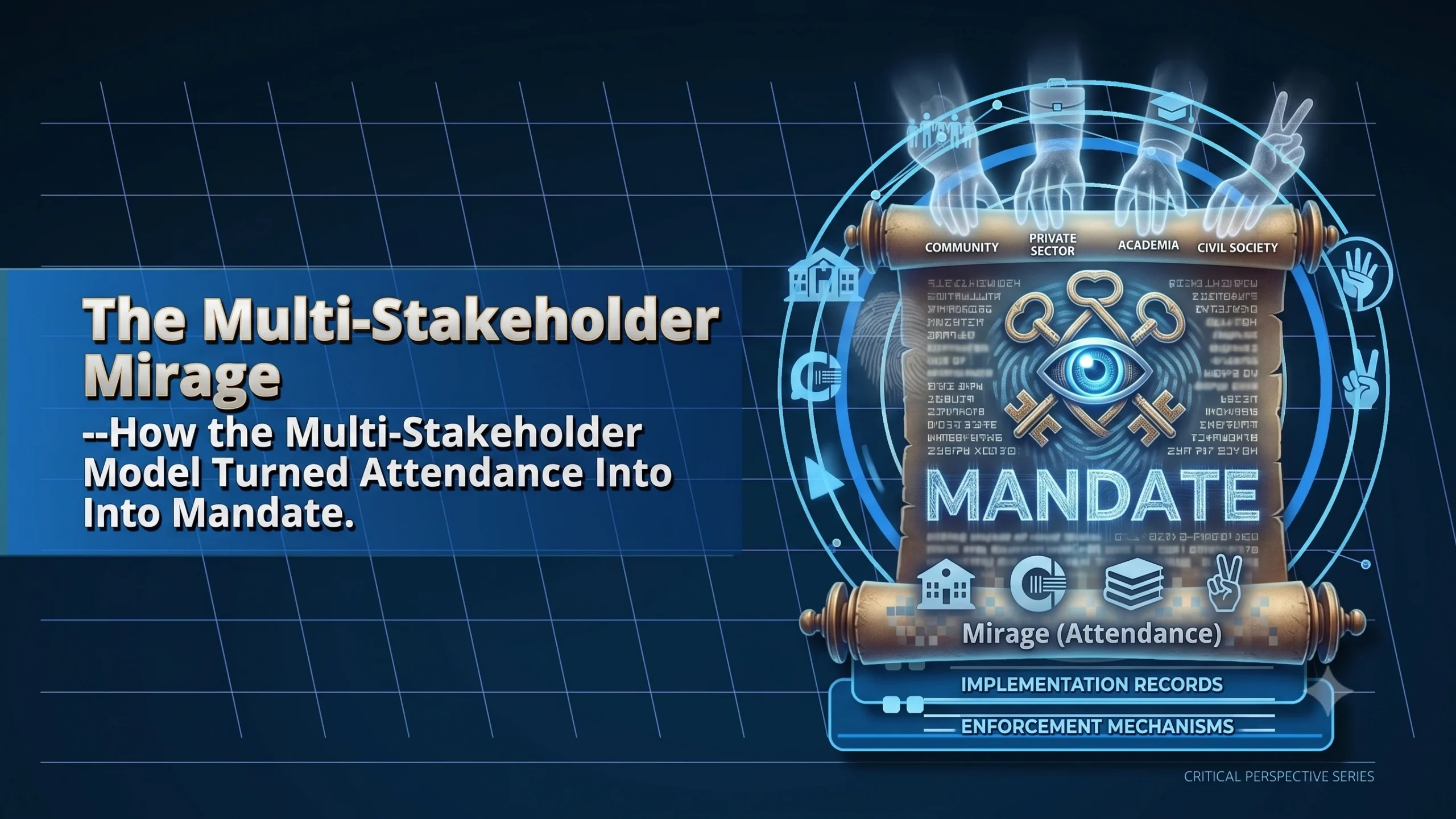
Note 73: The Multi-Stakeholder Mirage –How the Multi-Stakeholder Model Turned Attendance Into Mandate
Note 73: The Multi-Stakeholder Mirage –How the Multi-Stakeholder Model Turned Attendance Into Mandate Written by Lu Heng | July 4, […]
Read More
About Lu Heng: Notes
I am the CEO of LARUS Limited and the founder of the LARUS Foundation. I work at the intersection of Internet infrastructure, IP address markets, and global Internet governance.
Over the past years, I have been directly involved in disputes, policy processes, and structural failures across Regional Internet Registries (RIRs), including all five of them. What I write here is not theoretical commentary; it is drawn from first-hand exposure to how the Internet’s core resources are actually governed, misgoverned, priced, and controlled.
For readers with no prior exposure to Internet governance or IP address policy, A Beginner’s Guide to Lu Heng’s Notes offers a clear, accessible starting point written specifically for the general public.
The Internet’s most critical assets—IP addresses and the systems that govern them—are deeply misunderstood.
That misunderstanding has now become economically, legally, and strategically dangerous.
IPv4 is a scarce, irreplaceable service-enabling asset that underpins every cloud service, telecom network, and digital business on Earth. Yet its value is artificially suppressed by outdated policies, lack of ownership recognition, restricted liquidity, and governance captured by small technical circles rather than real asset owners.
This suppression is not abstract—it directly depresses the valuation of ISPs, cloud providers, and infrastructure companies worldwide.
At the same time, the institutions managing these assets operate as centralized choke points with weak accountability, no real failover mechanisms, and disproportionate power relative to their mandate.
This creates systemic risk: governance failures, political pressure, legal capture, or even financial distress at a single registry can threaten entire networks or regions. Phishing attacks exploiting fear of registry authority are a symptom of this deeper structural flaw.
These notes are my attempt to state the problem clearly, strip away institutional mythology, and articulate first-principles solutions:
I also write to explain the economic implications plainly—why IPv4 is massively undervalued today, why it can rationally reach tens of trillions in value once markets are allowed to function, and why this represents the largest unrealized wealth transfer opportunity the infrastructure sector has ever seen.
This is not advocacy for disruption for its own sake, nor personal grievance dressed up as theory.
It is a record of observations, arguments, and proposals intended for CEOs, board members, regulators, engineers, investors, and policymakers and public at large who rely on the Internet but rarely question the foundations it rests on.
If these notes are uncomfortable, that is intentional. Comfort is how structural failures persist.
Note 73: The Multi-Stakeholder Mirage –How the Multi-Stakeholder Model Turned Attendance Into Mandate Written by Lu Heng | July 4, […]
Read More
Note 72: The Bill of Rights of Uniqueness Coordination Written by Lu Heng | July 1, 2026 CEO of LARUS […]
Read More
Note 71: The Policy Mirror How AFRINIC’s 2026 Rules Turn the Registry from Ledger into Capital Control Written by Lu […]
Read More