Can Internet Coordination Evolve Beyond Registry Authority?
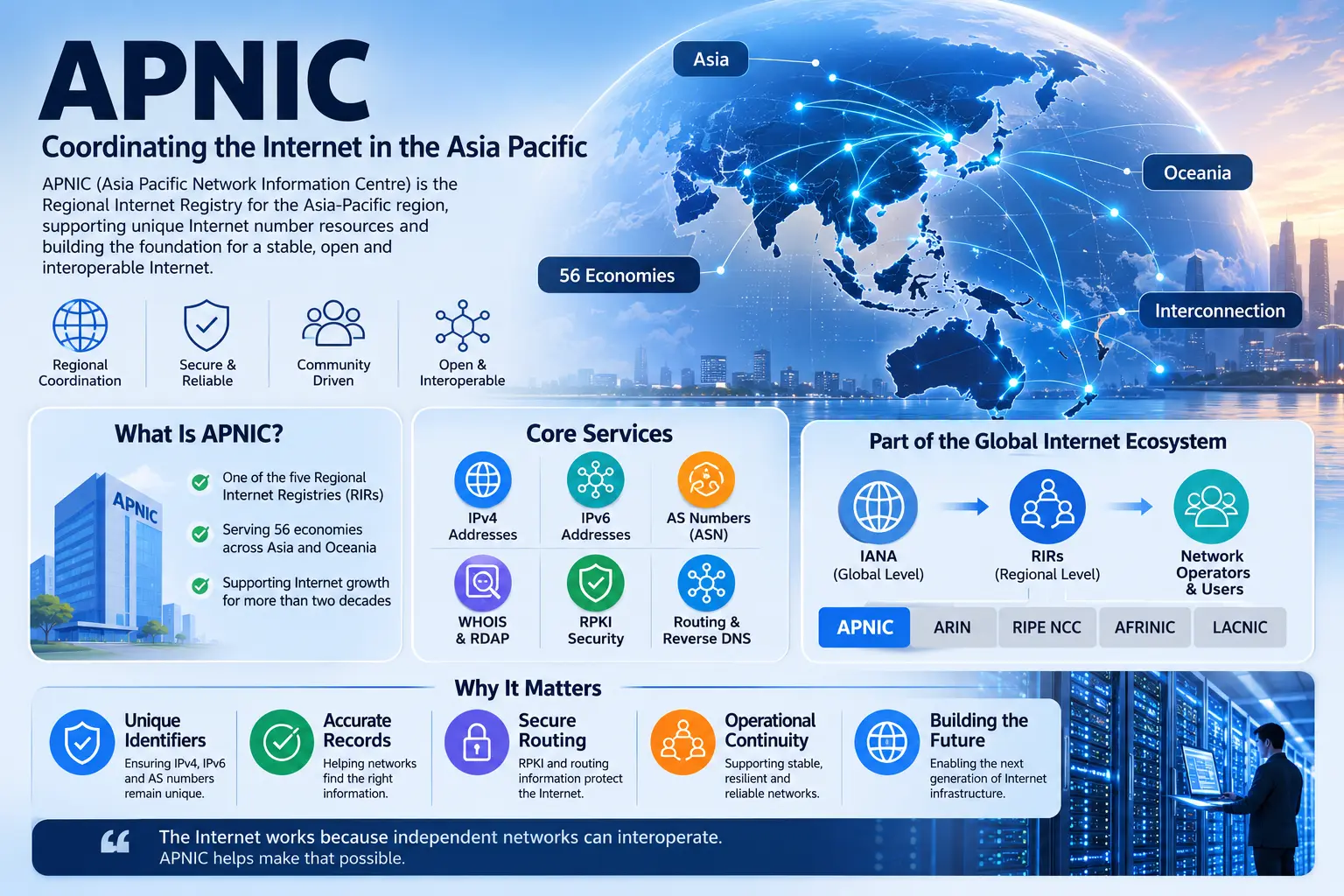
For most of the Internet’s operational history, global coordination has relied on a simple but powerful idea: that certain resources must be uniquely allocated, and therefore must be managed by specialized registry institutions. This logic produced the modern Internet number governance system, built around Regional Internet Registries (RIRs) such as ARIN, RIPE NCC, APNIC, LACNIC, and AFRINIC.
These institutions were designed to solve a narrow technical constraint: uniqueness at global scale. But over time, the boundary between “coordination” and “authority” has blurred. The question now is not whether coordination is necessary—it is whether registry-based authority remains the only viable mechanism for achieving it.
1. The Original Premise: Coordination Without Sovereignty
At its core, Internet number coordination was never intended to be sovereign governance. The early design assumption was minimalism:
- IP addresses must be globally unique
- Routing identifiers must not collide
- Allocation must be consistent across regions
- Administrative overhead must remain lightweight
This produced a distributed model of regional registries rather than a single global authority. The structure was elegant because it avoided central political control while maintaining technical coherence.
In theory, RIRs function as neutral coordinators. They do not “own” address space; they allocate it. They do not legislate; they administer policy developed through community processes. They do not govern states; they serve networks.
That theory is still repeated frequently. The practical reality is more complex.
2. The Drift From Coordination to Authority
Over time, registry functions expanded beyond simple allocation. What began as database maintenance evolved into multi-layered governance:
- Policy interpretation
- Eligibility determination
- Transfer approval systems
- Dispute resolution frameworks
- Resource revocation mechanisms
- Compliance enforcement structures
Each of these functions introduces discretion. And discretion, once institutionalized, becomes authority.
This shift is subtle because it does not resemble traditional state power. It is exercised through administrative conditions rather than law. But for operators and states alike, the effect can be structurally significant: access, continuity, and legitimacy of critical numbering resources become conditional on registry-defined processes.
This is where coordination begins to resemble governance.
3. The Structural Asymmetry Problem
A central tension in the current model is asymmetry between consequence and liability.
Registry institutions may sit in relatively constrained legal environments, often structured as nonprofit or membership-based entities under domestic law. Yet the systems they manage have global operational consequences.
This creates a structural imbalance:
- High downstream dependency (global Internet continuity)
- Moderate upstream accountability (localized legal frameworks)
- Limited liability exposure relative to systemic impact
Whether one interprets this as a flaw or a design necessity depends on perspective. But the asymmetry itself is difficult to ignore.
In such a system, the registry layer becomes more than a coordinator. It becomes a conditional gatekeeper of continuity.
4. The Sovereignty Question Emerges Indirectly
The term “sovereignty” is often introduced too late in these discussions, usually as a political accusation. But the structural issue is independent of rhetoric.
When states rely on infrastructure whose continuity depends on foreign-incorporated institutions—such as ARIN in Virginia or RIPE NCC under Dutch law in Amsterdam—they are implicitly embedding critical dependencies into external legal geographies.
This does not mean control is exercised arbitrarily or maliciously. In fact, the system is generally stable and professionally managed. The issue is not intent—it is architecture.
The question becomes:
Can a state fully claim infrastructural sovereignty if key continuity functions sit outside its legal jurisdiction?
5. Why Registry Authority Persisted
Despite its tension points, the registry model persists for practical reasons:
1. Path dependence
The system worked early, so it scaled globally without redesign.
2. Operational trust
Networks value predictability more than theoretical purity.
3. Fragmented governance preference
No state wanted centralized control of global Internet identifiers.
4. Institutional inertia
Existing coordination bodies became embedded in technical and policy ecosystems.
In other words, the system is not maintained because it is optimal, but because it is stable.
6. Can Coordination Be Decoupled From Authority?
This is the central question. To evolve beyond registry authority, coordination must be separated from discretionary control.
A next-generation model would likely require:
A. Pure Coordination Layer
A minimal global system responsible only for:
- Ensuring uniqueness
- Maintaining distributed registries
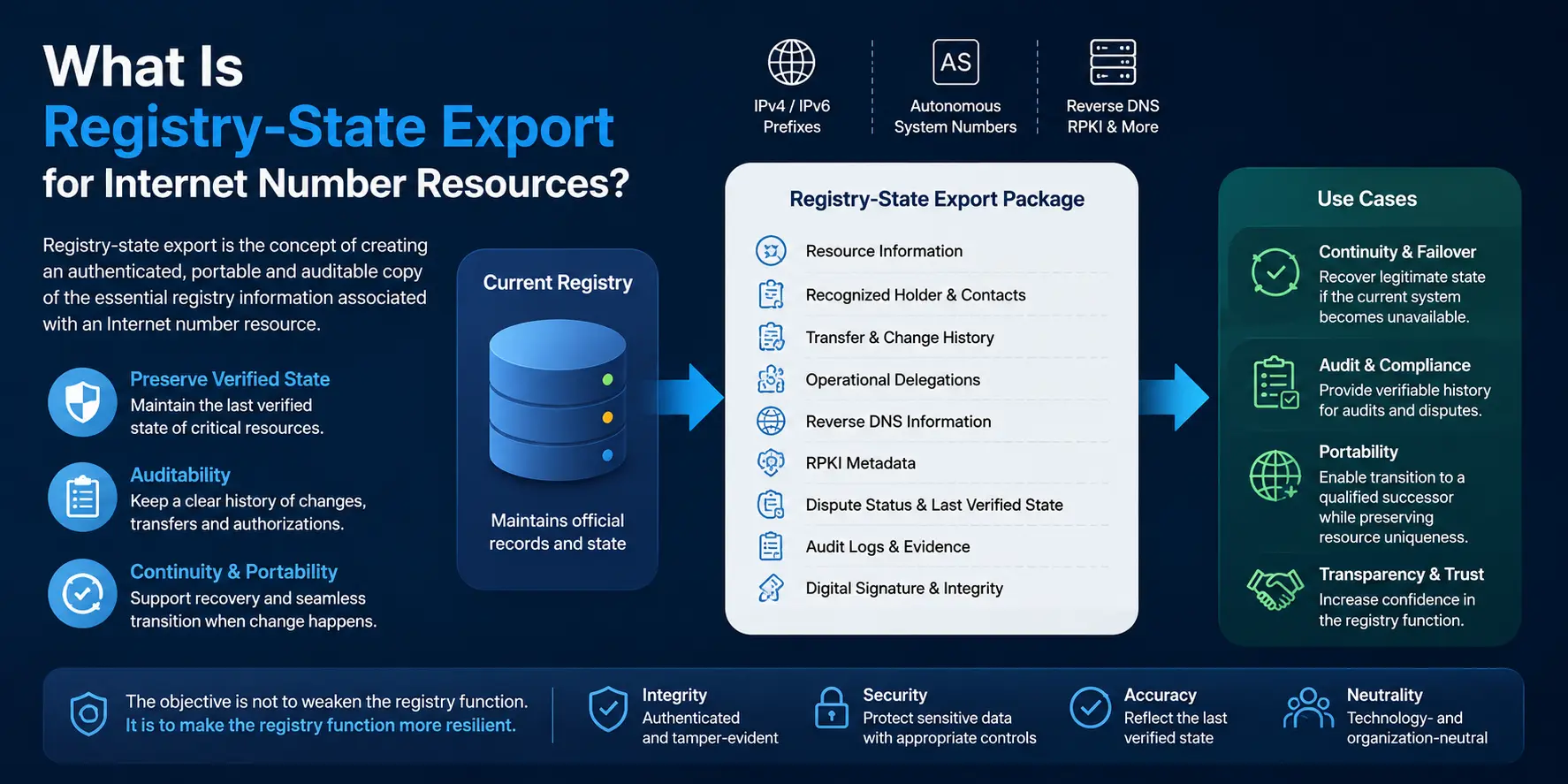
- Providing cryptographic verification of allocation states
No policy discretion. No eligibility judgment. No revocation authority.
B. Sovereign Policy Layer
All substantive decisions involving:
- Legal disputes
- Transfer legitimacy
- Sanctions or restrictions
- Institutional recognition
…would move back under national legal systems or treaty-based frameworks.
C. Cryptographic Transparency Layer
Instead of administrative trust, the system would rely on:
- Verifiable logs
- Public auditability
- Machine-verifiable allocation history
This would reduce reliance on institutional discretion entirely.
7. What Breaks in a Registry-Free Authority Model?
Critics of this idea typically point to fragmentation risks. Without centralized registry authority, they argue:
- Conflicts in allocation could re-emerge
- Policy divergence may reduce interoperability
- Coordination overhead could increase
These are valid concerns—but they assume that authority is the only mechanism that can enforce consistency.
Modern distributed systems challenge this assumption. Cryptographic consensus, distributed ledgers, and multi-stakeholder validation systems show that coordination does not necessarily require discretionary governance.
The real question is not whether authority is effective—it is whether it is still necessary.
8. The Real Constraint: Trust Substitution
Registry systems exist because they substitute for trust. They allow global actors who do not trust each other—or share legal systems—to still coordinate a shared namespace.
This substitution worked well in an earlier Internet era. But today:
- Infrastructure is more critical
- State dependency is higher
- Economic value is concentrated in digital systems
- Operational risk is systemic rather than local
As stakes rise, reliance on discretionary trust becomes less stable.
This is where registry authority becomes most contested—not because it expanded, but because the environment around it changed.
9. Evolution Does Not Require Collapse
It is important to distinguish reform from disruption. The evolution beyond registry authority does not require dismantling existing institutions overnight.
Instead, it may involve:
- Gradual reduction of discretionary scope
- Migration of policy decisions to jurisdictional frameworks
- Increased automation of allocation logic
- Separation of database function from governance function
In such a model, institutions like RIRs could continue to exist—but as technical coordination utilities rather than policy actors.
10. Conclusion: From Authority Back to Infrastructure
The Internet began as a system of coordination without sovereignty. Over time, registry institutions accumulated hybrid characteristics: part technical infrastructure, part governance layer.
The question now is not whether they are legitimate in historical terms—they are. The question is whether their current role remains the appropriate abstraction layer for a world where digital infrastructure is economically and politically foundational.
Coordination does not inherently require authority. It requires consistency, transparency, and minimal ambiguity. Authority introduces discretion, and discretion introduces political and structural asymmetry.
So the real evolution question is simple:
Can the Internet return registry systems to their original role as infrastructure coordinators—without allowing them to remain de facto governance institutions?
The answer will likely define the next phase of Internet architecture, not as a technical upgrade, but as an institutional redesign.
FAQs
Yes, but not in the formal or treaty-based sense. The system operated by ARIN, RIPE NCC, APNIC, LACNIC, and AFRINIC functions as a governance layer in practice because it can condition access, continuity, and transfer of critical Internet numbering resources. The distinction between “coordination” and “governance” is therefore structural rather than semantic.
Replacement is not necessarily binary or disruptive. A structural evolution could separate:
- a minimal coordination layer for uniqueness
- a sovereign policy layer for legal and political decisions
- a transparent verification layer for auditability
The key constraint is not technical feasibility, but institutional transition and global coordination agreement.