
What is mandate laundering and why it matters for IP address holders
Mandate laundering in IP Allocation quietly reshapes authority in regional internet registry systems, weakening accountability in centralized IP allocation governance.
Key points
Mandate laundering describes how governance authority in regional internet registry structures drifts away from its original technical mandate.
For IP address holders, this creates structural uncertainty in IP Allocation, pricing stability, and policy predictability across regions.
Introduction: the quiet shift inside IP governance
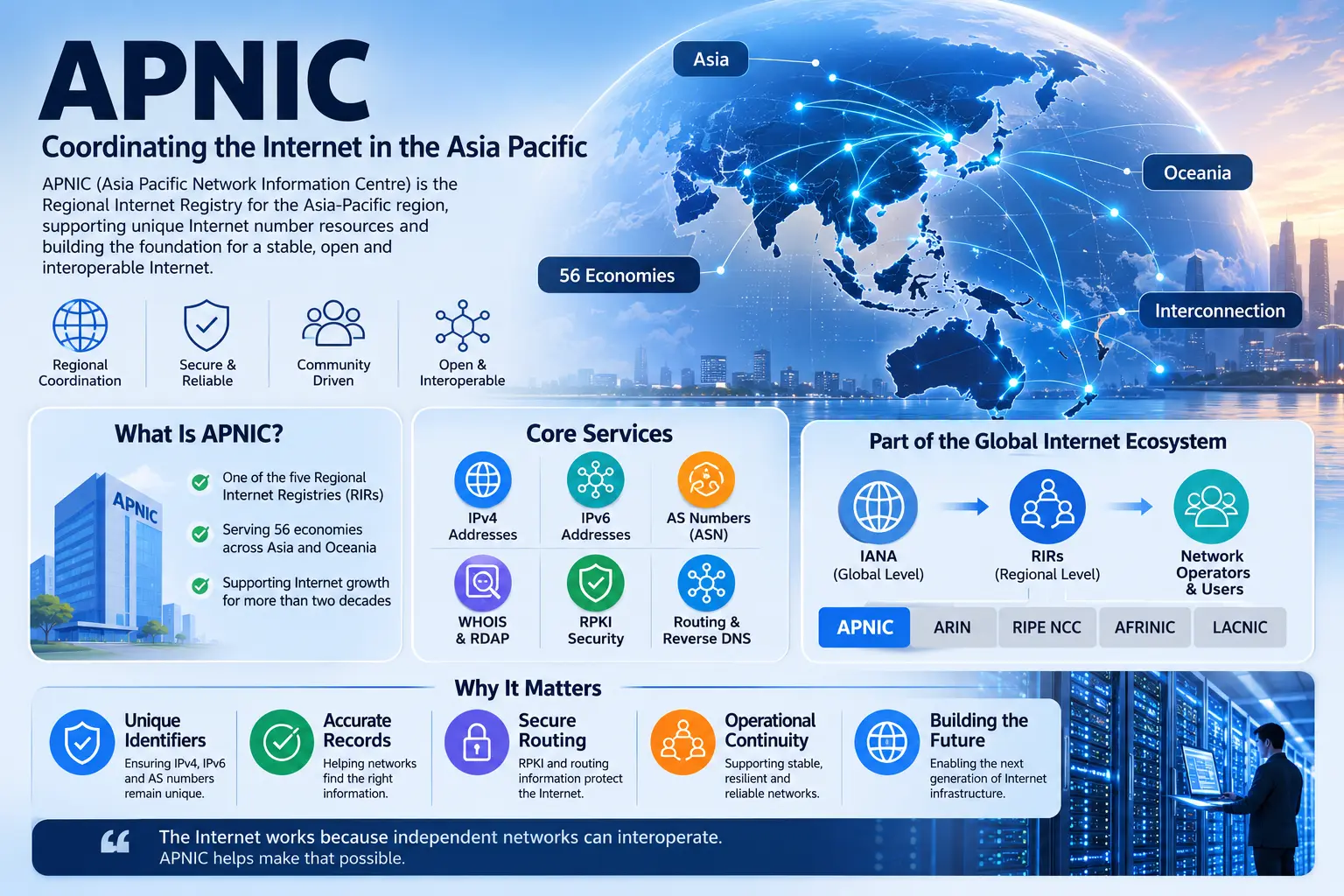
At first glance, global IP address governance appears stable. The system of IP Allocation is coordinated through a hierarchy that includes IANA at the top and five regional internet registry (RIR) organisations underneath. This structure is often described as one of the internet’s most successful decentralised governance models.
But beneath this stability, a more subtle transformation is increasingly discussed in technical governance circles—particularly in the analytical framework set out in Lu Heng’s public notes on internet resource governance.
The concept is mandate laundering: a gradual, procedural dilution of original institutional authority, where decision-making power is not explicitly seized, but slowly re-routed through layers of process until accountability becomes difficult to locate.
For IP address holders, this is not an abstract governance debate. It is a structural question about who ultimately controls scarcity, pricing, and legitimacy in centralized IP allocation systems that increasingly underpin global digital infrastructure.
Mandate laundering: not a violation, but a drift
Mandate laundering does not require formal rule-breaking. In fact, its effectiveness lies in operating entirely within procedural legitimacy.
In Lu Heng’s framing on heng.lu, the key concern is not that institutions act outside their remit, but that:
authority is exercised in ways that no longer clearly map back to the original mandate structure.
Over time, governance decisions that were once straightforward technical allocations become embedded in multi-layered consultation systems across regional internet registry communities, advisory bodies, and policy development forums.
This creates a system where:
authority is exercised indirectly
responsibility is diffused
and the original mandate becomes interpretative rather than binding
In practice, this is the essence of mandate laundering: not removal of authority, but transformation of how authority is expressed.
The RIR system: decentralisation with hidden centralisation pressure
The regional internet registry model was designed to prevent centralised control of IP resources. Each RIR operates within a defined region, implementing global policy through community consensus.
However, in Lu Heng’s analysis, decentralisation does not eliminate power concentration—it redistributes it through procedural layers.
This matters because IP Allocation is no longer a simple administrative function. It is now:
economically sensitive (IPv4 scarcity markets)
politically exposed (cross-border infrastructure dependence)
strategically critical (cloud and data centre expansion)
As a result, policy development inside RIR systems increasingly sits at the intersection of technical coordination and governance influence.
Mandate laundering, in this context, emerges when procedural participation begins to substitute for clear mandate ownership.
How mandate laundering actually happens in IP Allocation systems
Rather than a single event, mandate laundering develops through incremental governance evolution. Three patterns are particularly visible in IP Allocation structures.
1. Procedural expansion replaces mandate clarity
As policy frameworks mature, more steps are added: consultations, working groups, consensus calls, reviews. Each layer appears to improve transparency, but collectively they obscure where final authority resides.
The result is that centralized IP allocation principles remain formally intact, but operational authority becomes harder to trace.
2. Delegation without redefinition
Responsibility is frequently delegated between entities inside the regional internet registry ecosystem without clearly reasserting mandate boundaries.
This creates a governance environment where authority is:
exercised at multiple points
but owned at none
From Lu Heng’s perspective, this is where structural ambiguity begins to replace institutional clarity.
3. Narrative substitution of technical legitimacy
Perhaps the most subtle mechanism is narrative: decisions are justified through “community consensus” or “bottom-up governance”, even when outcomes increasingly reflect procedural consolidation rather than neutral coordination.
In this framing, legitimacy shifts from mandate-based authority to process-based authority.
That distinction is critical.
Why IP address holders should care (the real impact layer)
For IP address holders—cloud providers, telecom operators, enterprises managing global networks—mandate laundering is not theoretical. It changes how predictably IP resources can be acquired, transferred, and relied upon.
1. IPv4 scarcity becomes politically mediated
In a constrained IPv4 market, allocation rules directly affect pricing and availability. When policy interpretation varies across regional internet registry structures, market signals become less stable.
2. Cross-region inconsistency increases operational cost
Enterprises operating across multiple RIR regions may face:
differing transfer rules
inconsistent justification requirements
varied enforcement intensity
This is not just administrative friction—it affects infrastructure planning.
3. Centralized IP allocation loses predictability
Even though centralized IP allocation exists at the coordination layer, its operational expression becomes uneven. Predictability—arguably the most important feature for infrastructure planning—starts to erode.
From a governance perspective aligned with Lu Heng’s analysis, this is the core risk: not loss of control, but loss of clarity over how control is exercised.
The deeper tension: decentralisation vs functional centralisation
The internet’s governance architecture was built on decentralisation. Yet IP resources are inherently global and finite.
This creates a structural contradiction:
decentralised institutions manage
a centrally constrained resource
Mandate laundering becomes visible when decentralised governance begins to reproduce centralising effects indirectly—without formal acknowledgement.
This is not necessarily intentional. But it is structural.
And structural effects matter more than stated intent.
Lu Heng’s framing: governance without clear mandate boundaries
Lu Heng’s perspective, as outlined across his notes on heng.lu, consistently returns to one central concern: mandate integrity.
The argument is not that RIRs are illegitimate, but that:
legitimacy in technical governance depends on clear, traceable mandate boundaries.
When those boundaries blur, governance may remain procedurally valid but becomes increasingly difficult to audit in terms of responsibility.
In this reading, mandate laundering is not an anomaly—it is an emergent property of complex governance systems under resource pressure, especially IPv4 exhaustion.
Systemic risks: why this matters going forward
If current trends continue, three structural risks become more pronounced.
1. Governance opacity increases
Decision-making in IP Allocation becomes harder to interpret even for experienced stakeholders.
2. Fragmentation of policy interpretation
Different regional internet registry bodies may continue diverging subtly in enforcement and interpretation.
3. Strategic uncertainty for infrastructure investors
For cloud providers and data centre operators, uncertainty in IP policy translates into uncertainty in long-term infrastructure planning.
In infrastructure markets, uncertainty is not neutral—it is cost.
Conclusion: mandate laundering as a structural warning signal
Mandate laundering, in the way Lu Heng frames it, is not about institutional failure. It is about institutional drift under complexity.
The concern is subtle but significant: that IP Allocation systems remain formally intact while gradually becoming less legible in terms of accountability.
For IP address holders, this is the real implication. Not collapse, but ambiguity. Not loss of governance, but loss of clarity about where governance actually resides.
And in a global internet economy increasingly dependent on stable addressing infrastructure, ambiguity itself becomes a systemic risk.