Note:34 On Why RIR Enforcement Creep Is the Silent Killer of IPv4 Liquidity — and Why It Must Be Stopped
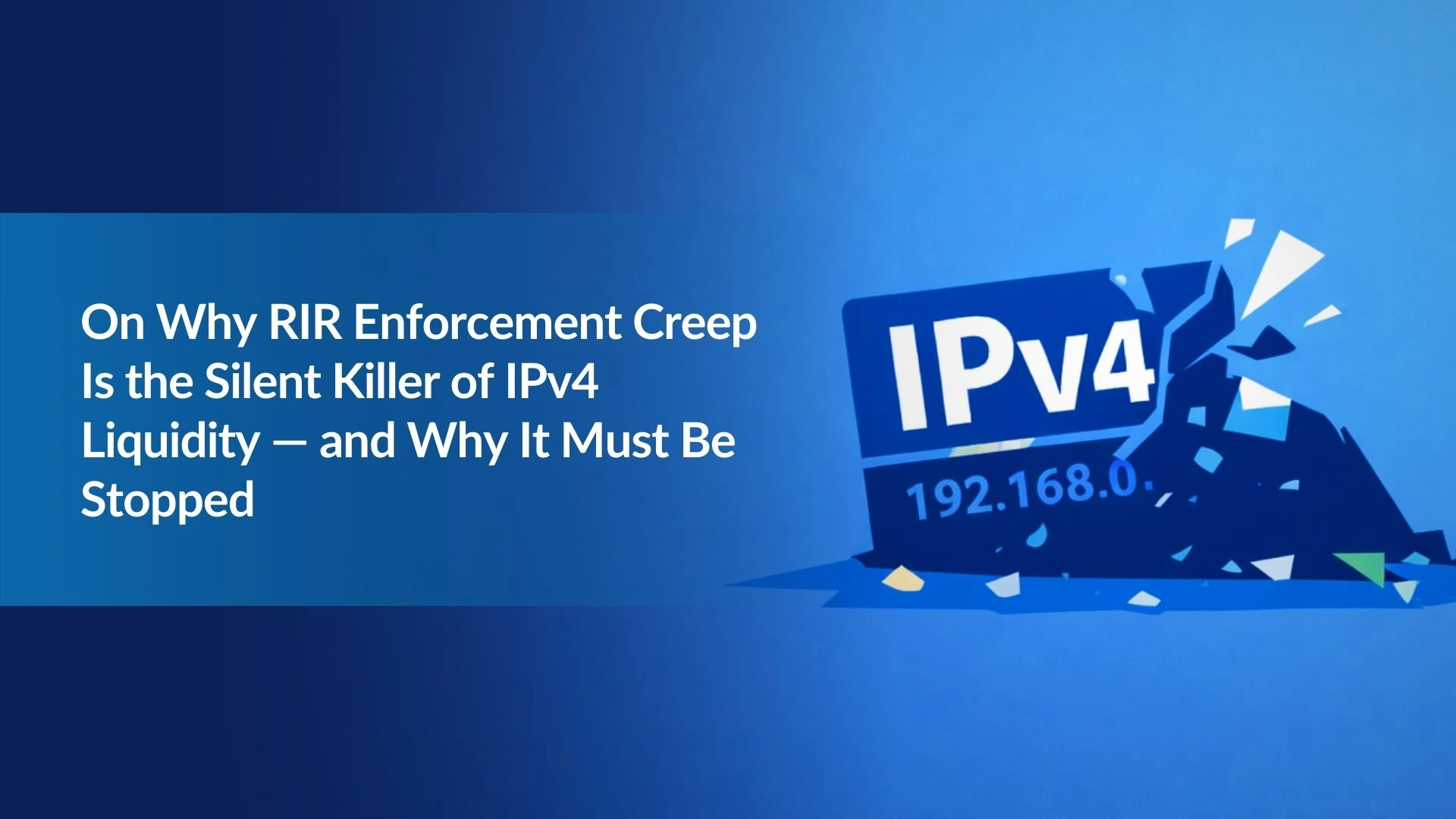
RIR enforcement creep is rarely discussed openly, but it has become the single largest invisible threat to IPv4 liquidity. RIRs were originally designed to register and record address space. That was their mandate. Over time, this narrow role has quietly expanded into something far more intrusive: auditing transactions, freezing transfers, retroactively questioning historical usage, and intervening in secondary markets under the banner of “policy compliance.” The framing sounds responsible. The reality is a steady accumulation of power by actors who do not buy IPv4, do not hold it, and do not bear its carrying cost—yet increasingly decide who may sell, who may buy, and under what conditions.
This is not market stewardship. It is rationing logic, reintroduced through technical language. History has already shown how this pattern ends. In centrally planned economies, when scarcity exists but price signals are politically inconvenient, bureaucracies invent need-based allocation. Money alone is no longer sufficient; approval is required. Ownership becomes conditional. The result is always the same: liquidity collapses, black markets emerge, capital freezes, and scarce assets remain structurally undervalued. IPv4 is now being pushed down the same path. You may “own” address space, but your ability to transfer it depends on passing an opaque and ever-changing definition of need, historical justification, and administrative acceptability.
The market impact is immediate and predictable. Liquidity dries up. Operators, cloud providers, and infrastructure players with real skin in the game hesitate to transact at scale, not because demand is weak, but because enforcement risk is asymmetric and impossible to price. One audit trigger, one retroactive interpretation, one compliance objection, and a rational transaction can be delayed, reversed, or rendered toxic. The market ceases to function as a market. Price discovery is replaced by permission-seeking. You think you are trading an asset; in reality, you are applying for a ration coupon.
The economic mechanics are unforgiving. Real liquidity requires clear price signals. Clear price signals allow capital to compound. Compounding capital is how IPv4 evolves from a technical resource into a trillion-dollar asset class. Enforcement creep does the opposite: it suppresses liquidity, artificially caps prices, and locks capital into defensive, low-velocity holding patterns. Ownership becomes symbolic. Assets exist, but cannot move freely enough to express their true value. No rational buyer pays a premium for a “compliance badge” unless forced to—and today, that force is concentrated in custodians who do not bear the consequences of mispricing or capital destruction.
What emerges is a permanent enforcement tax. On the surface, the system appears orderly and moral, described as “protecting the community.” In substance, it reproduces the worst failures of need-based allocation: scarcity without price, ownership without control, and markets reduced to administrative queues. Like all rationing systems, it primarily protects the institution issuing approvals—its authority, its budget, and its relevance—not the underlying economy.
This must stop. Registration bodies should not become police. Transfer review should not become a rationing mechanism. IPv4 liquidity should not be sacrificed to abstract “community risk” narratives that lack measurable economic grounding. Control must return to those with real exposure: CEOs, shareholders, and the people who actually build and operate networks. Let markets determine transfer value. Let risk be priced, not administratively imposed. Let ownership mean ownership again.
When enforcement creep finally ends, it will not be because RIRs lost a political battle. It will be because the industry acknowledged a lesson history has already made clear: need-based control of scarce assets does not preserve value. It systematically destroys it.