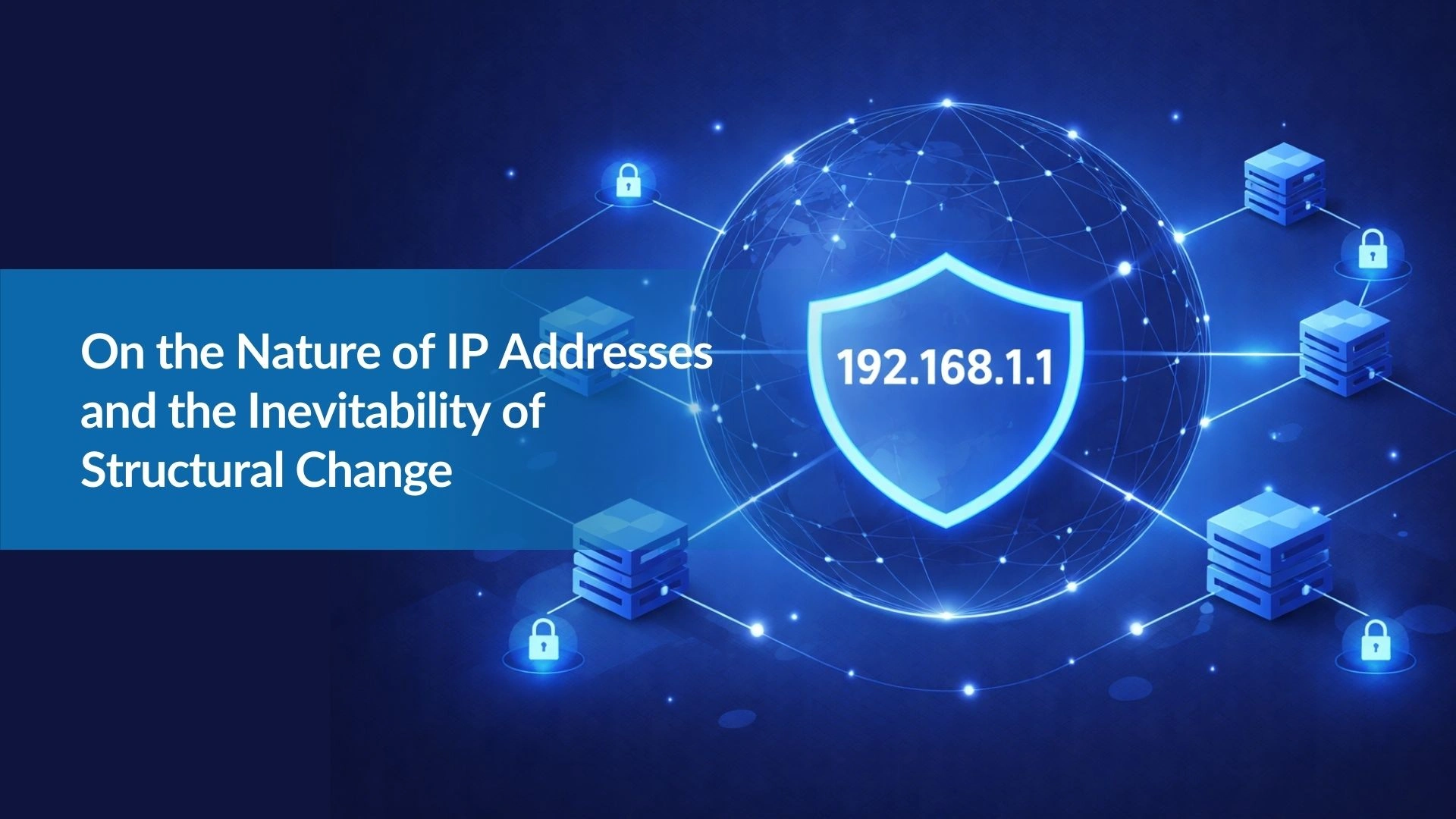
Note:48 On the Nature of IP Addresses and the Inevitability of Structural Change
To understand why the current governance debate exists at all, one must begin with a simple question: what exactly is an IP address?
The Origin of IP Addresses
IP addresses were created in the early days of the Internet as a practical engineering solution. Networks needed a way to uniquely identify devices connected to the network so that packets could be routed from one machine to another. The Internet Protocol therefore introduced a simple concept: a numerical identifier assigned to each node participating in the network.
IPv4, designed in the late 1970s and early 1980s, used a 32-bit number to represent this identifier. At the time, the Internet was a research network, not a global economic infrastructure. Address allocation was informal. Early administrators simply recorded who was using which numbers so that routing conflicts would not occur.
The key principle was not ownership or authority.
The key principle was uniqueness.
As long as two networks did not claim the same identifier at the same time, the system functioned.
The Nature of the Identifier
This reveals something fundamental about IP addresses.
An IP address is not land.
It is not spectrum.
It is not a physical resource.
It is a unique numerical label recorded in a ledger so that global routing can function.
From a purely technical perspective, the identity of the entity maintaining that ledger is secondary. What matters is that the records remain globally consistent and non-conflicting.
In other words:
The Internet does not depend on who records the addresses.
It depends on the integrity of the record itself.
The Emergence of Economic Value
For decades, IP addresses were simply operational identifiers. But as the Internet expanded into a global economic system, those identifiers became essential inputs to digital infrastructure.
Web services required them.
Cloud infrastructure required them.
Content delivery required them.
Eventually, markets emerged.
Organizations began buying, leasing, and transferring IP addresses. Prices appeared. Contracts formed. Companies recorded address blocks as balance-sheet assets.
The market itself revealed a fact that governance structures had not anticipated:
IP addresses had become capital assets.
Not because administrators declared them so.
Because operators behaved as if they were.
Markets do not create value through rhetoric.
They reveal value through transactions.
The Governance Contradiction
Here is where the structural contradiction appears.
The institutions that administer IP address registries perform an important function: they maintain the global allocation ledger and coordinate routing records.
But these institutions generally do not claim ownership of the addresses themselves.
At the same time, they typically limit their legal liability to extremely small amounts in their contracts—sometimes on the order of $100.
This creates a peculiar arrangement:
• Operators treat IP addresses as valuable assets.
• Markets price and trade them accordingly.
• Registry institutions maintain administrative control over allocation records.
• Yet those same institutions do not own the assets and assume almost no financial liability if discretionary actions affect them.
In other words, the current system separates authority from economic responsibility.
That separation might have been tolerable when addresses were merely operational identifiers. But once they became capital assets worth billions collectively, the governance model became economically and legally inconsistent.
A Structural Break
Markets have already resolved the question of value.
Operators treat IP addresses as property-like assets because their networks depend on them. Infrastructure investment depends on them. Business continuity depends on them.
But the institutional structure managing those identifiers was designed for a world where addresses had little economic significance.
This creates a structural break:
The economic layer treats addresses as assets.
The administrative layer treats them as revocable allocations.
The two logics cannot coexist indefinitely.
Why Decentralization Becomes Inevitable
When a system reaches this type of contradiction, change does not occur because someone demands it. Change occurs because the underlying incentives no longer align.
Operators require:
• predictable property rights
• neutral record-keeping
• protection from arbitrary revocation
Markets require:
• transparent ledgers
• verifiable ownership
• enforceable transfers
Once these requirements dominate, the question naturally emerges:
If IP addresses are simply unique identifiers recorded in a ledger, and the economic value of those identifiers now exceeds the authority structures designed to manage them, why should the ledger remain centralized under institutions that neither own the assets nor bear their risk?
The logical answer becomes clear.
The ledger itself must evolve.
Just as financial markets moved toward distributed settlement systems and transparent transaction records, the Internet’s addressing system will eventually move toward governance models where rules replace discretionary authority.
Not because of ideology.
Because the current model contains a structural contradiction.
The Conclusion
IP addresses began as simple numerical identifiers.
Markets transformed them into infrastructure assets.
But the institutions governing them still operate under assumptions from a different era.
When economic reality and governance design diverge, systems eventually restructure.
The Internet does not depend on who keeps the ledger.
It depends on the accuracy and neutrality of the ledger itself.
And when neutrality cannot be guaranteed by centralized authority without ownership or liability, the system will search for new mechanisms.
That is why decentralization is not merely possible.
It is the logical endpoint of the system’s evolution.
And once that process begins, the existing governance structure cannot remain unchanged.
Not because someone wishes it to collapse.
But because the mathematics of the system no longer supports it.