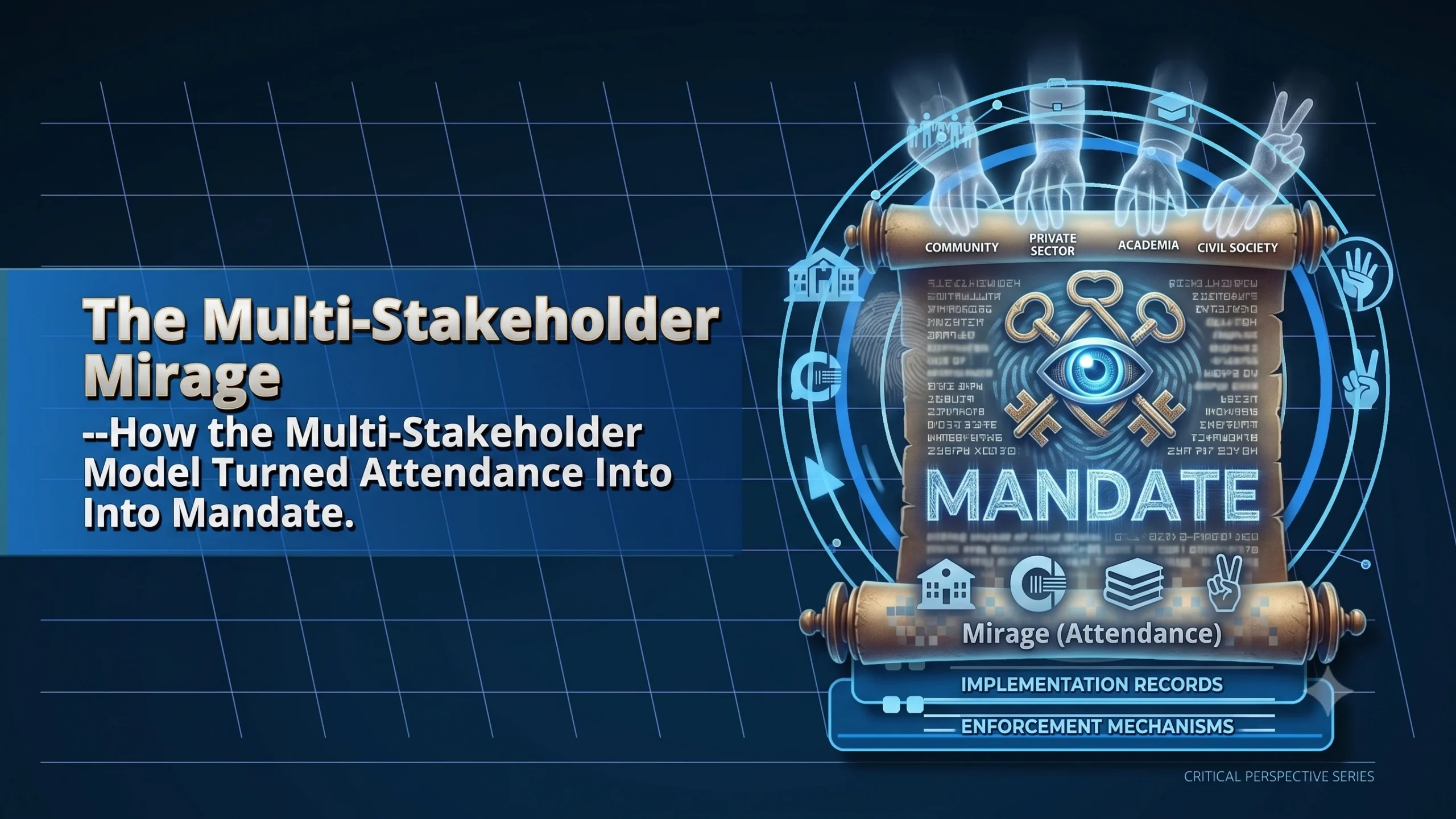
Note:25 On the Last Attempt to Centralize the Internet — the ICP-2 Revision Draft, Implementation Power, and Structural Risk
Every system eventually reaches a moment when it must either adapt to reality or attempt to freeze itself in place.
That moment is not decided by debate.
It is decided by scale.
The Internet has reached that moment.
The ICP-2 Revision Draft is presented as protection, stewardship, and order.
In reality, it is an attempt to preserve a structure that no longer fits the scale or nature of the system it claims to govern.
The core mistake is simple.
The problem is not that global trust has weakened.
Global trust never existed.
If centralized trust were possible at planetary scale, we would already have a world government.
We do not.
We never will.
The Internet did not succeed because trust existed.
It succeeded because trust was irrelevant.
When the Internet was small, abundance concealed fragility.
When IP addresses were plentiful, governance barely mattered.
When failure was local, mistakes were survivable.
That phase is over.
The Internet is now critical infrastructure.
IP addresses are now productive capital.
Failure is global.
Fragility is no longer acceptable.
At this point, systems face a choice.
They can remove choke points.
Or they can defend them.
They can allow exit.
Or they can attempt to forbid it.
They can decentralize.
Or they can concentrate authority and call it safety.
The ICP-2 Revision Draft chooses concentration.
It blocks entry.
It restricts exit.
It makes new institutions practically impossible and existing ones effectively irreplaceable.
It converts coordination into permission.
And permission into power.
Worse, it does this without genuine community consent, placing decisive authority in the hands of a private corporation and calling it governance.
This is not stabilization.
It is entrenchment.
The structural flaw is decisive.
ICANN and the NRO possess no coercive force.
They command no armies.
They control no borders.
They cannot compel compliance.
Their authority exists entirely through voluntary cooperation.
That is precisely why this approach is fatal.
A system built on voluntary participation collapses the moment it restricts exit, blocks competition, and concentrates authority—because it destroys the only foundation it depends on.
Consent is the system.
Those who remain too long inside institutional comfort begin to mistake proximity to process for real power.
They confuse a self-selecting community with the world it claims to represent.
This is not naïve.
It is structurally unsound.
The moment compliance shifts from voluntary alignment to perceived coercion, legitimacy evaporates.
There is no enforcement layer to absorb the shock.
No buffer.
No fallback.
Unlike historical empires, this system cannot impose order.
It can only persuade.
And when persuasion is replaced by entrenchment, cooperation does not resist.
It exits.
This is why centralization here is uniquely fragile.
In trying to protect itself, the system destroys the very conditions that made it viable.
History repeats this pattern relentlessly.
When threatened, old systems close.
They block exit.
They defend privilege.
They mistake control for stability.
Kings did this.
Authoritarian regimes did this.
Planned economies did this.
All believed they were preserving order.
All accelerated collapse.
Systems do not fail because challengers attack them.
They fail because, in trying to protect themselves, they suppress adaptation, defend choke points, and forbid exit.
The ICP-2 Revision Draft follows this exact path.
It frames a structural transition as a morality play: good institutions versus bad actors, order versus chaos.
That framing is not merely wrong.
It is fatal.
Complex systems do not collapse because someone is evil.
They collapse because assumptions stop scaling, incentives diverge, and choke points are defended instead of removed.
In hindsight, accelerating the breakdown of the old model may not be a tragedy.
It may be necessary.
A system that refuses to evolve yet lacks force cannot stabilize.
It can only lose consent.
And when consent is gone, the system does not fall violently.
It is quietly routed around.
Nations do not trust one another.
They never have.
But nations cannot afford to lose the Internet.
That contradiction leaves only one outcome.
Critical Internet resources cannot depend on centralized permission—not because trust disappeared, but because centralized trust was never achievable.
When coordination fails, systems either break or decentralize.
The Internet already chose decentralization once, at the network layer.
History now demands the same choice at the resource layer.
The ICP-2 Revision Draft is not preventing that future.
It is confirming it.
The conflict will pass.
The names will fade.
But the direction is fixed.
When a system built on consent tries to survive by closing,
it ensures that what replaces it will replace it entirely.