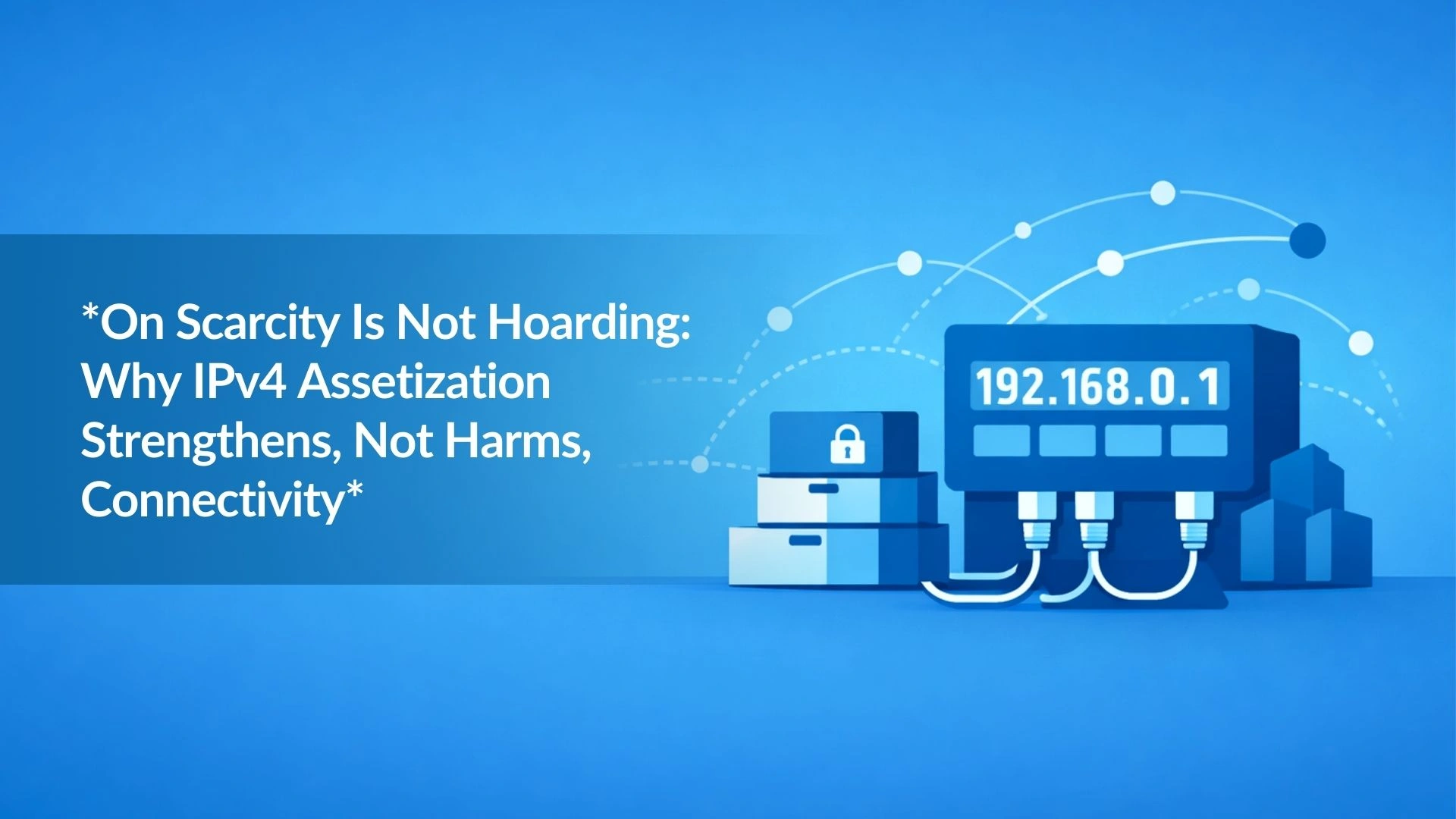
Note:39 On Scarcity Is Not Hoarding: Why IPv4 Assetization Strengthens, Not Harms, Connectivity
The claim that recognizing IPv4 as an asset will “jack up connectivity prices” collapses under minimal value-chain analysis. Connectivity is not priced by IP addresses; it is priced by equipment vendors, fiber infrastructure, power, real estate, spectrum, and upstream transit. Cisco, Juniper, Nokia, fiber manufacturers, and energy providers are trillion- or multi-billion-dollar industries extracting the overwhelming majority of value. ISPs—especially access-layer and regional operators—operate on the thinnest margins in the chain. They deploy and operate networks, absorb regulatory risk, and are blamed for prices they do not set.
The reason ISPs are structurally poor is straightforward: historically, they owned nothing scarce. In capitalism, scarcity is the prerequisite for pricing power—no scarcity, no rent. For decades, ISPs were confined to a pass-through role while upstream vendors captured monopoly rents via patents, proprietary hardware, and switching costs. IPv4 is the first truly global, unavoidable scarcity ISPs have legitimately possessed. It is not an external input; it is an internal production factor. That is precisely why elements of the governance establishment seek to frame it as “community property” rather than ISP-held capital.
This is not about preventing price increases; it is about appropriating scarcity. When insiders argue that IPv4 must remain under stewardship control “for the public good,” they are attempting to confiscate the only scarce asset ISPs have in order to preserve perpetual administrative control. The moral framing exists because the economic argument fails. If IPv4 were insignificant, control over it would not matter.
Even under deliberately extreme assumptions, the accusation fails. If IPv4 prices rose by 1,000× or even 3,000×, the impact on end-user connectivity would remain marginal—on the order of 0.1% to 1% of the total cost stack. IP addresses are not routers, fiber, power, labor, or spectrum. Relative to rents extracted elsewhere, they are a rounding error. Claiming that IPv4 pricing blocks connectivity is mathematically false.
After exhaustion of the central free pool, insisting on “need-based” allocation becomes not only obsolete but structurally harmful. It mirrors command-economy logic: formal collective ownership paired with permissioned access. Allocation by demonstrated “need” does not eliminate scarcity; it transfers power to approvers. Because “need” is undefined and unverifiable, such systems predictably generate discretion, delay, favoritism, and corruption. This is not a flaw; it is the mechanism—and it is why insiders favor it.
The recurring image of “a poor child in Africa denied Internet access because of IPv4 pricing” is therefore not merely wrong but cynical. That child is disconnected because the overwhelming costs sit in infrastructure owned by global vendors, utilities, and governments—not because of a few additional dollars per IP per year. IPv4 moralization conveniently diverts blame from real cost centers to the weakest actor in the chain.
More importantly, preventing ISPs from valuing their only scarce asset weakens the very actors capable of last-mile expansion. Margin-starved operators cannot finance densification, rural builds, redundancy, or resilience. Asset recognition converts IPv4 from a hidden constraint into deployable capital—enabling leasing, collateralization, and reinvestment. Suppressing scarcity does not produce inclusion; it produces fragility.
This dynamic is reinforced by insider behavior. A small, embedded group routinely misleads ISPs and technical leadership by presenting discretionary control as stability and moral necessity. They optimize for process over outcomes, defend committee power, and attack arguments grounded in network economics. The result is perverse: ISPs are persuaded to argue against their own interests, preserving a structure in which they remain poor while others extract rents.
ISPs should stop apologizing. Scarcity is not a sin; it is the basis of sustainability. This is the first moment in Internet history when ISPs can participate in capital formation rather than permanent margin compression. Treating IPv4 as an asset does not meaningfully raise prices; it reallocates value to the only actors who actually build and operate networks.
The real question is not whether IPv4 is scarce—it already is—but who is permitted to benefit from that scarcity. Either ISPs capture it and reinvest in networks, or administrators and vendors continue extracting rents while preaching morality. The former leads to decentralization and resilience; the latter preserves a system in which ISPs remain poor, blamed, and politically convenient.