Note:46 On the Absurdity of the IPv6 “Escape from Scarcity” Narrative
In real estate there is a famous rule: location, location, location.
A house in Manhattan can cost $1.3–$2.8 million on average, while houses in towns a couple of hours away can sell for a few hundred thousand dollars or less.
The buildings are still houses. They have walls, roofs, plumbing. Structurally they are not radically different.
Yet people pay many times more to live in Manhattan.
Why?
Because location matters.
The network you connect to matters.
The ecosystem around the asset matters.
A cheaper house two hours away comes with a cost: commuting, transportation, time, and disruption of daily life.
Now imagine something absurd.
Imagine Manhattan apartments cost less than 1% of someone’s salary.
Would anyone seriously move two hours away just to save that tiny amount?
Would people buy a car, spend hours commuting every day, and rebuild their entire routine just to avoid paying something that insignificant?
Of course not.
The idea would be ridiculous.
Yet this is exactly the logic being pushed in the IPv4 versus IPv6 debate.
Today, leasing an IPv4 address typically costs around $0.30–$0.50 per month, or roughly $5–6 per year.
Meanwhile, a normal cloud server commonly costs $100–$500 per month, depending on workload.
That means the IP address represents far less than 1% of the infrastructure cost.
In economic terms, IPv4 addresses are not constraining deployment.
They are a rounding error.
Calling this situation “scarcity” is therefore not an economic observation. It is a narrative.
And the narrative serves a purpose.
The narrative of IPv4 exhaustion is continually reinforced by the incumbent power networks surrounding the registries, an old-boy structure that benefits from pushing the Internet toward IPv6.
But the comparison itself is fundamentally flawed.
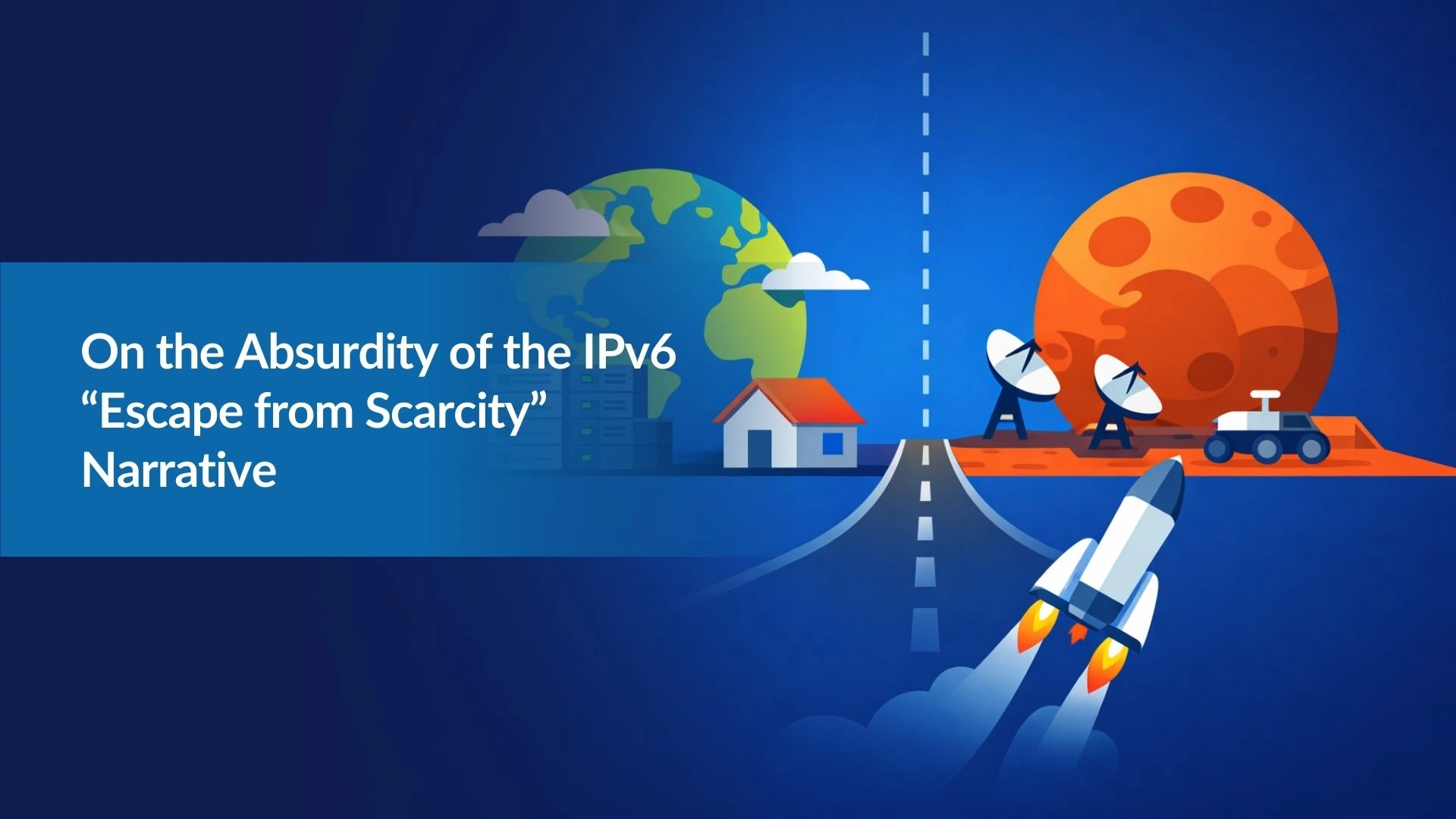
IPv4 and IPv6 are not simply two houses in different neighborhoods.
They are more like Earth and Mars.
They are not even naturally interconnected.
IPv6 is not merely a bigger version of IPv4. It is a separate network space that requires operators to maintain dual-stack infrastructure, additional routing, additional firewall rules, additional operational complexity, and additional engineering work.
In other words, the Internet is being asked to move two hours away and buy a car—not because Manhattan became unaffordable, but because someone declared it so.
Operators must run both systems at once. They must maintain compatibility layers. They must absorb the operational overhead.
The entire ecosystem pays a dual-stack tax.
And all of this is justified by the claim that IPv4 addresses are scarce.
But when the supposed scarce resource costs less than one percent of the infrastructure that uses it, the claim begins to look less like engineering reality and more like institutional propaganda.
The engineering argument also weakens under inspection.
IPv4 uses a 32-bit address space. On paper that yields about 4.3 billion addresses.
But real networks do not operate under a one-device-one-address model.
Technologies such as Network Address Translation (NAT) allow thousands—or even millions—of devices to share a single public IPv4 address through layered internal addressing. In effect, the usable addressing capacity expands far beyond the raw 32-bit count.
Meanwhile IPv6 offers a vastly larger theoretical space, but practical deployments commonly allocate networks in /48 or /56 blocks—enormous allocations relative to actual device requirements.
The practical operational difference often becomes far smaller than the raw mathematical expansion suggests.
What remains is not a technological necessity but an institutional incentive.
If IPv4 is recognized as functioning capital infrastructure—traded, leased, and priced by markets—then the registry layer becomes a ledger operator rather than a resource gatekeeper.
And that raises uncomfortable questions about authority and liability.
Many registry contracts limit their own liability to symbolic amounts—sometimes around $100—while exercising administrative authority over assets worth billions collectively.
The scarcity narrative helps sustain this arrangement.
If IPv4 is portrayed as fragile and exhausted, then centralized guardianship appears necessary and discretionary authority remains unquestioned.
But when the economic math is examined honestly, the story becomes harder to defend.
Operators are effectively being told:
Move to a distant network space.
Run two infrastructures.
Absorb operational complexity.
Pay the dual-stack tax.
All to avoid paying less than one percent of their infrastructure cost.
That is not rational engineering.
That is asking the entire Internet to behave irrationally.
In real estate, nobody abandons Manhattan when rent costs 0.1% of income.
And in networking, nobody abandons a functioning global addressing system because its cost is negligible.
Scarcity that does not constrain behavior is not scarcity.
It is narrative.
And narratives collapse when confronted with arithmetic.